Claude agents on company servers: what responsibility moves with them?
Self-hosting changes who operates an agent service, but task authority, outbound data and recovery still need separate scrutiny.
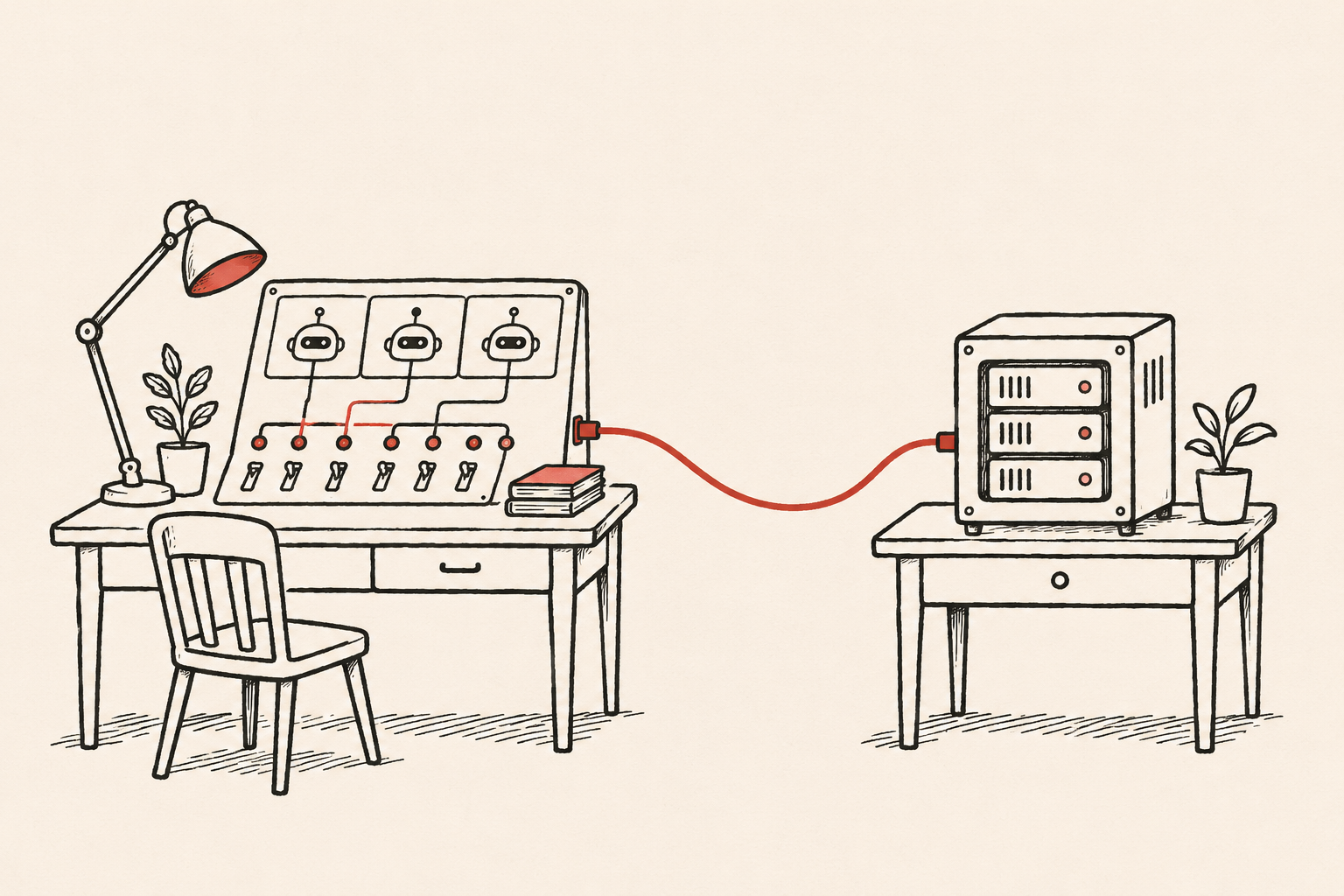
On 12 November 2026, Anthropic announced a private beta of self-hosted Claude Managed Agents. Access requires contacting its account team; this is not general availability. Announcement, 12 November
The consequential question is not whether AI can sit on company servers. It is which operating responsibilities the company intends to take over. What follows is Open Market Notes analysis of public materials, not a deployment test or a judgment about any company's compliance.
Local execution and local management are separate purchases
Self-hosted sandboxes moved tool execution. The new option also puts the service, sessions and history under customer hosting. Inference still runs at the chosen provider. Hosting architecture
That distinction changes a procurement discussion. Consider a hypothetical software company asking an agent to investigate failed builds. Initially, the questions might concern repository location and where tests run. Once agents work for longer periods, the company also needs to establish who commissioned a task, which authorization allowed a change, and whether an interrupted job should resume or terminate. An execution machine on a private network cannot answer those questions alone.
Requirements should therefore distinguish the execution environment, task management and model calls. An organization may need control over only the first, or independent custody of records for the first two. Those demands carry different costs. Calling all of them “local deployment” risks presenting unresolved requirements as completed work.
Holding records does not mean nothing leaves
The data documentation says model calls include conversations and tool inputs and results. Retention at the inference provider depends on the arrangement with that provider. Data and access
A review should follow an actual task rather than stop at an infrastructure diagram. A build error can contain a customer identifier; a test fixture can contain production samples. Not uploading an entire file does not establish that its contents are absent from the model's context. Conversely, preventing every tool result from leaving can remove the information needed to solve the problem.
A useful evaluation starts by defining the minimum information necessary for the question, then examines whether actual requests exceed it. Diagnosing an interface test may require only redacted field differences, not a complete customer record. That is a design objective, not a guarantee this article attributes to the product. Approved request samples and enforceable outbound rules are better acceptance evidence than the phrase “data stays local.”
Permissions concern actions, not just login
The sandbox security documentation assigns tool-process permissions, outbound network restrictions and runtime hardening to the customer. Sandbox security model
Owning a server does not mean an agent should inherit its administrator's capabilities. An agent that reads failed-test logs and one that can modify a pipeline and trigger production releases should not receive identical authority merely because they use the same model.
In our hypothetical workflow, a sensible boundary lets diagnosis produce a proposed fix and a reviewable diff. Merging or releasing belongs to a separate process with explicit conditions. This does not require people to inspect every automated operation. It separates repeatable analysis from irreversible actions or changes affecting external users. Authorization should also attach to a task's scope: one repair request should not silently become indefinite permission to maintain every repository.
Supporting workflows determine migration cost
The differences documentation says hosted history is not automatically copied over. The self-hosted version has neither built-in scheduled deployments nor webhooks. Current feature differences
A successful demonstration is therefore insufficient. Suppose an existing workflow relies on a timer to start and a completion notification to update a ticket. Its core reasoning can work while the business process fails at initiation or delivery. Each connection needs an accountable owner and a decision about whether rebuilding it is worthwhile.
This is the practical comparison with a finished hosted service. More control also means more internal coordination. If a company has no requirement to hold task state itself and only needs test tools to reach a private network, taking over the entire management service may be unnecessary. Additional control is valuable when it meets a specific requirement, not simply because it is available.
Recovery tests must include business effects
The upgrade guide warns that restoring a backup loses subsequent database writes and can restore environment keys that were valid at backup time but revoked later. Upgrade and recovery guidance
In an ordinary application, recovery is often described as returning to an earlier correct state. An agent workflow also needs to reconcile what already happened outside that state. If an agent created a repair ticket before its session record was rolled back, will another run create a duplicate? If it already requested a release, how will an approver distinguish the old request from a new task?
These are proposed acceptance-test scenarios, not disclosed product incidents. Success means more than restarting a service. It includes reconciliation of external actions, ownership of pending jobs and checking whether old authority has reappeared. Only then can a team judge whether the control it has acquired is usable.
Assess responsibility, not an abstract promise of safety
The update offers another allocation of responsibilities. Public evidence does not establish that every adopting team will become cheaper, more reliable or more compliant. Nor should private-beta feature differences be treated as permanent boundaries.
Our preferred pilot would constrain one observable workflow and retain a hosted alternative for comparison. Alongside completion rates, measure who intervenes after failure, investigation time, whether revocation works, and which team bears maintenance costs. Clearer answers indicate a real operational gain. If those answers remain vague, changing the deployment location will not itself improve governance.
Information only. No investment, legal, tax, or financial advice.