Chevron’s adjusted cash flow needs a funding-duration test
Cash-flow adjustments help comparison, but recurring payments require a separate test of funding duration and flexibility.
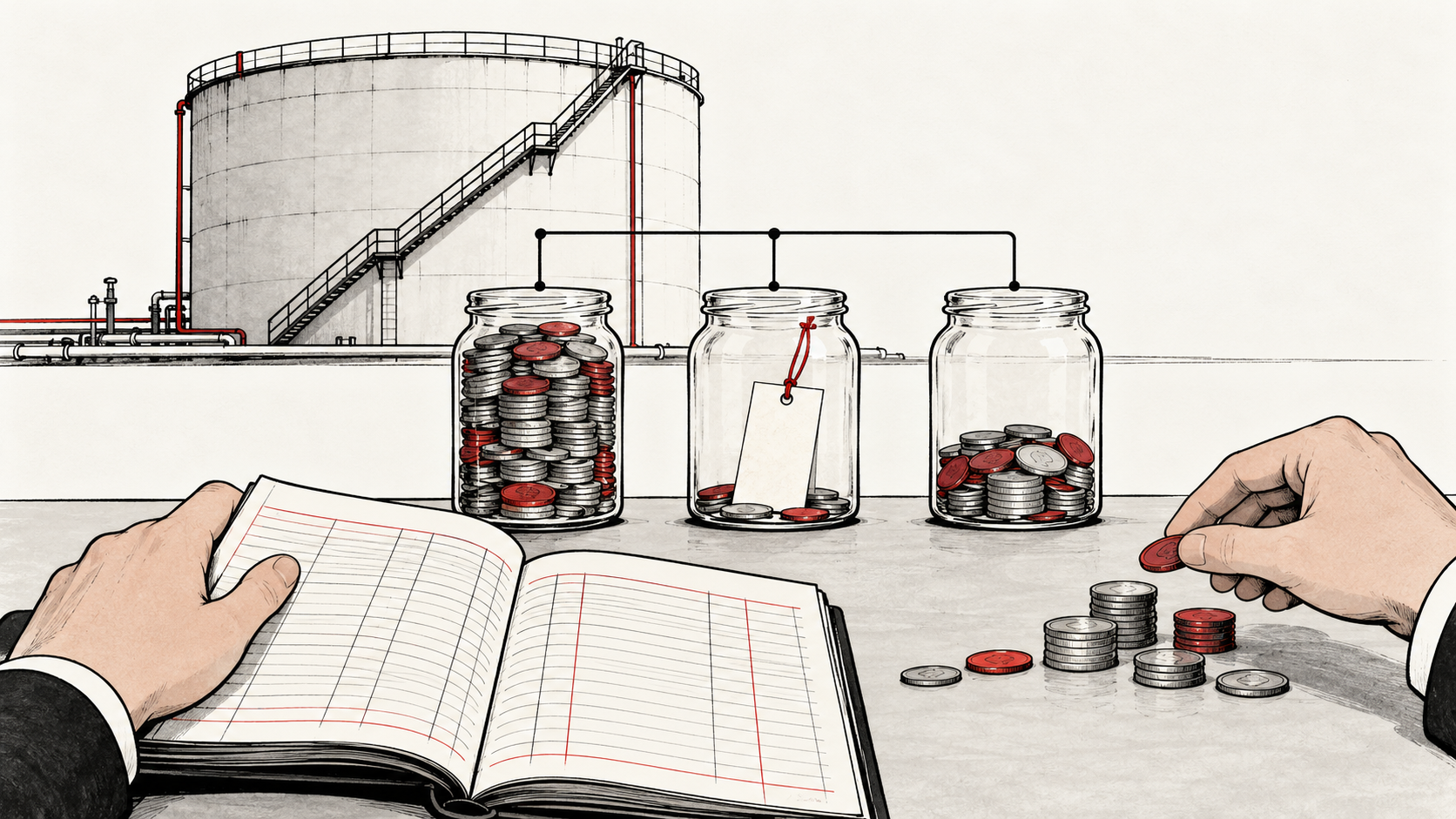
Chevron’s October 30, 2026 release reports third-quarter free cash flow of $12.0 billion, or $14.2 billion adjusted—both non-GAAP measures. Reconciliation items include working capital, asset sales and affiliate-loan movements. Company release
Those figures invite a question about the next decision, not simply a preference for the larger or smaller number. How much of a quarter’s funding can support a payment that management expects to repeat? The following framework is Open Market Notes’ analysis, not Chevron guidance or a forecast of its distributions.
Reconcile first, then ask what can repeat
A reconciliation explains how one reported measure becomes another. A funding plan has a different job: it must establish when money can actually be used and what obligations survive that use. A correctly calculated adjustment can be useful for comparing operating performance while still needing a separate liquidity test.
Consider a hypothetical industrial group collecting a loan it previously made to a partner. Cash returns, but a receivable also disappears. The transaction may reduce exposure and make capital available for another purpose. It does not, by itself, show that customers are paying more for the group’s products. Calling all such receipts poor-quality cash would miss their economic value. Treating them as a new quarterly production rate would make the opposite mistake.
An asset disposal raises a related but different question. The analyst should compare the money recovered with the future contribution surrendered and any costs that remain with the seller. A sensible sale can improve a portfolio even when it reduces reported revenue. Its value depends on the transaction and the alternatives; repetition cannot be assumed merely because the receipt enters a broad cash measure.
These are generic examples of how to analyze capital recovery, not assertions about the terms or merits of Chevron’s specific transactions.
Separate a timing adjustment from a cash receipt
Suppose a customer pays just after a reporting cutoff. Removing that timing effect may help compare periods. The supplier still has to fund payroll and other payments until collection. Analytical normalization changes the comparison; it does not move the bank receipt into an earlier week.
The useful question is therefore which adjustment will reverse, on what evidence, and within which funding window. A multi-quarter schedule can distinguish a seasonal fluctuation from money tied up for longer. If the business is expanding, part of the additional operating funding may remain necessary rather than unwind promptly. A scenario should say so instead of mechanically assuming that every adverse movement will be recovered next quarter.
The SEC’s longstanding free-cash-flow interpretation warns that mandatory uses can remain outside the measure. This is background guidance, not a new rule or a finding against Chevron. SEC, question 102.07
Match payment flexibility to funding uncertainty
For a hypothetical board, money that is already accessible could reduce debt, fund a project or support a discretionary repurchase. Each choice has a different consequence if the next period is weaker. Repaying a maturity removes an obligation; starting a multi-year project may create further funding needs. A recurring payout also establishes expectations, even where its future authorization remains discretionary.
A useful capital-allocation review would therefore show two views together. One follows cash received and payments due over the relevant horizon. The other estimates operating generation under explicitly stated assumptions. Capital recovered from past investments belongs in the first view; any assumed recurrence needs its own justification in the second. Neither view should silently fill gaps in the other.
This does not require dismissing management’s adjusted measure. It requires using it for a defined question and retaining the reconciliation when moving to another one. Readers can acknowledge a strong funding period without concluding that every source can finance the same annual commitment indefinitely.
The analysis should also preserve reversibility. If an expected receipt is delayed, which payments can move and which cannot? If money is usable only within a particular entity, how far can the group total support another entity’s payment? These questions do not imply existing distress. They make the plan’s failure conditions explicit before a gap appears.
What the quarter cannot settle
This article does not estimate Chevron’s sustainable payout, classify its individual disposals as good or bad, or forecast commodity prices. Those judgments need a fuller payment schedule, transaction details and forward operating assumptions than the two headline measures provide.
The practical next step is to label each source by its expected duration and each use by its flexibility, then test what happens if collection or replacement funding arrives later. That turns an adjusted total into a decision process whose assumptions can be checked in subsequent quarters.
Information only. No investment, legal, tax, or financial advice.