Celestica: who finances an AI hardware order before it becomes revenue?
Customer deposits, receivable finance and equity absorb different risks in the hardware production cycle.
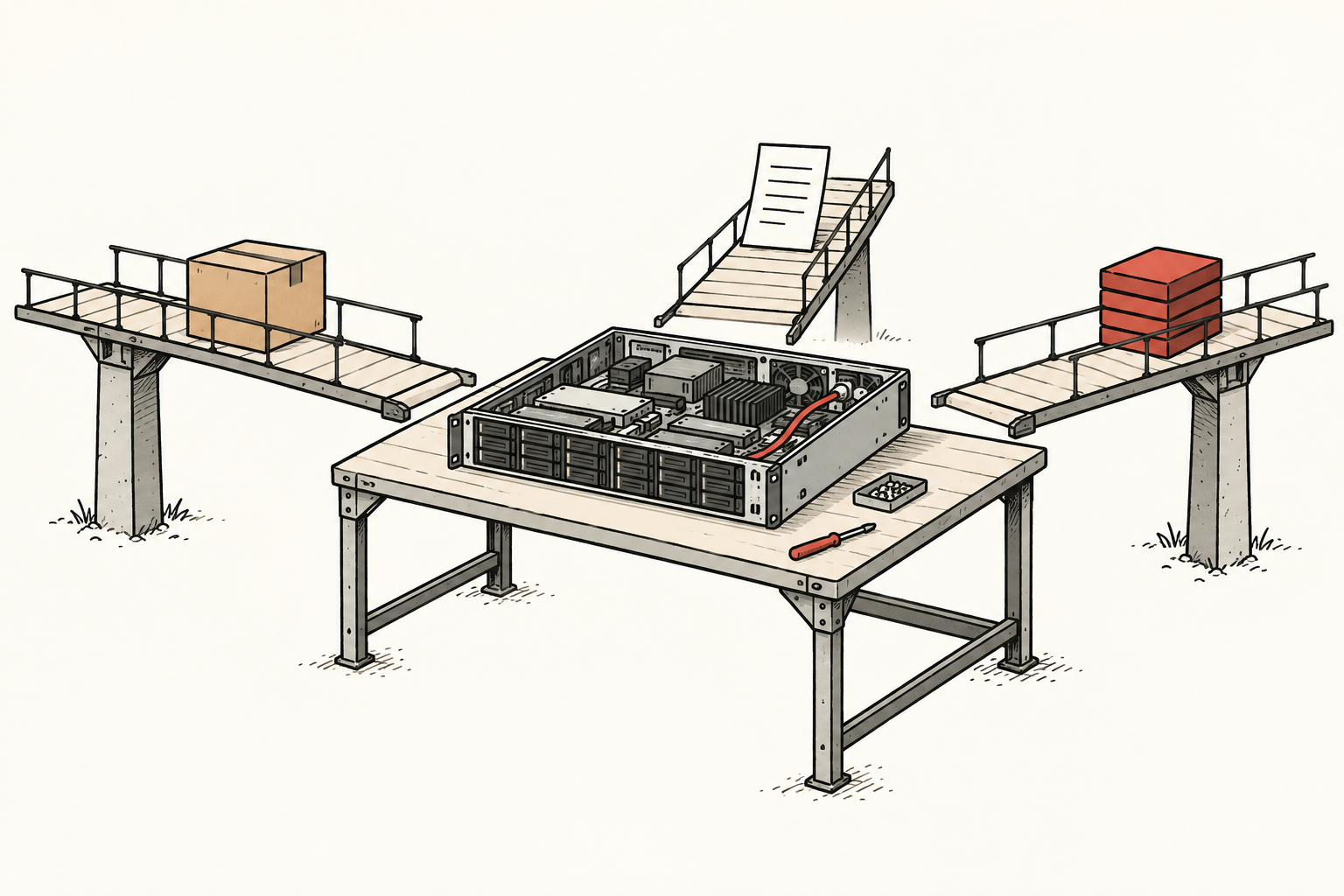
An AI infrastructure order is also an agreement about who will carry uncertainty before the finished equipment is paid for. For a manufacturer, the distinction between a customer forecasting demand and a customer putting money behind that demand can matter as much as the quantity ordered. Celestica provides a timely case for examining that distinction, without assuming that rapid expansion is either self-funding or inherently unhealthy.
On October 26, 2026, Celestica forecast 2027 capital expenditure of $1.5–2.0 billion. This is a plan, not completed spending. Quarterly release
The analytical question here goes beyond whether reported profit converts to cash in one quarter: which party funds each stage, and which risks remain after that funding arrives? The following framework is OMN analysis, not a description of undisclosed Celestica contract terms.
A deposit is not the same as a profitable sale
Celestica’s 2025 annual report describes customer inventory deposits and receivable-sale financing; it says the CCS customer receivable-financing program ended in February 2026. Annual report, pages 57 and 74
These arrangements should not be bundled into a single reassuring label such as “customer-backed growth.” A deposit can reduce the manufacturer’s need to fund components. It does not, by itself, establish the eventual margin, guarantee acceptance of finished equipment, or prove that every cost arising from a design change will be reimbursed. To know what protection exists, one needs the covered inventory, refund conditions and obligations when a program changes.
Consider an explicitly hypothetical order: a customer helps fund special components, but final assembly requires another qualification test. The deposit may protect cash already spent on those components while leaving labor, rework and idle equipment with the manufacturer. A different contract could allocate those costs to the customer. The existence of a deposit alone cannot distinguish between the two. This is why a contractual right to recover a cost and cash available today are different kinds of protection.
Financing a receivable changes timing, not the original economics
Selling a receivable can bring collection forward. Conceptually, this operates later in the production cycle than financing components in advance. It may shorten the interval between delivery and cash without changing the resources consumed before delivery. Fees, recourse and eligibility conditions also matter; they cannot be inferred from the word “financing.”
There is an equally important measurement problem. A low balance on the final day of a quarter does not describe every funding transaction during that quarter. Conversely, a large quarter-end balance need not mean that conditions worsened permanently. A useful comparison would separate gross activity, outstanding amounts and financing costs. It would also distinguish customer-sponsored arrangements from extensions of the manufacturer’s own payment terms to suppliers. Those mechanisms involve different counterparties and should not be treated as interchangeable.
Nothing in this framework establishes that Celestica is experiencing collection problems or relying on an undisclosed financing arrangement. The point is to prevent a category error: earlier cash receipt is not the same evidence as stronger product economics.
Equity supplies flexibility, but cannot validate a production plan
Celestica completed an equity offering on August 7, 2026, raising approximately $3.45 billion gross; stated uses included working capital and capital expenditure. Offering completion
Equity can absorb a longer period between investment and recovery without a scheduled principal repayment. That flexibility has a cost: more owners share the eventual economic outcome. Neither consequence settles whether the underlying expansion is attractive. It is possible to finance a valuable project with dilution, just as it is possible to retain an undiluted ownership structure in a business with insufficient room to execute its orders.
The practical question is how flexible the funded assets remain if demand changes. General-purpose equipment that can move between programs has different downside characteristics from a highly specialized line. Cash used for inventory also differs from cash committed to a building. Materials may turn over repeatedly; a production site must earn its place over a much longer period. Combining both under “growth investment” hides the duration and reversibility of the commitment.
Demand visibility and risk sharing are separate evidence
The constructive interpretation is straightforward: advance funding and capital raised before bottlenecks emerge can improve execution. Waiting for every order to generate its own cash could cause a manufacturer to miss viable opportunities. The competing interpretation is that abundant funding can postpone, rather than solve, a mismatch between capacity and realizable demand. Neither interpretation can be selected from a sales forecast alone.
The evidence that would discriminate between them is operational as well as financial. Do customer commitments cover the same assets that require investment? Can capacity be redeployed? When a program slips, does its deposit remain available, get refunded or become tied to another obligation? And after the production ramp, does cash recovery arrive without continually extending the funding bridge?
Public disclosures may not answer those questions contract by contract. That is an evidentiary limit, not evidence of hidden weakness. For Celestica, the useful next step is to follow how funding terms and asset commitments evolve together. Revenue growth describes the scale of the opportunity; the allocation of cancellation, collection and capacity risk describes how much of that opportunity the manufacturer can actually retain.
Information only. No investment, legal, tax, or financial advice.