After Arc: preserving the work behind the tabs
Browser migration should preserve how a task gets done, not just the links that remain.
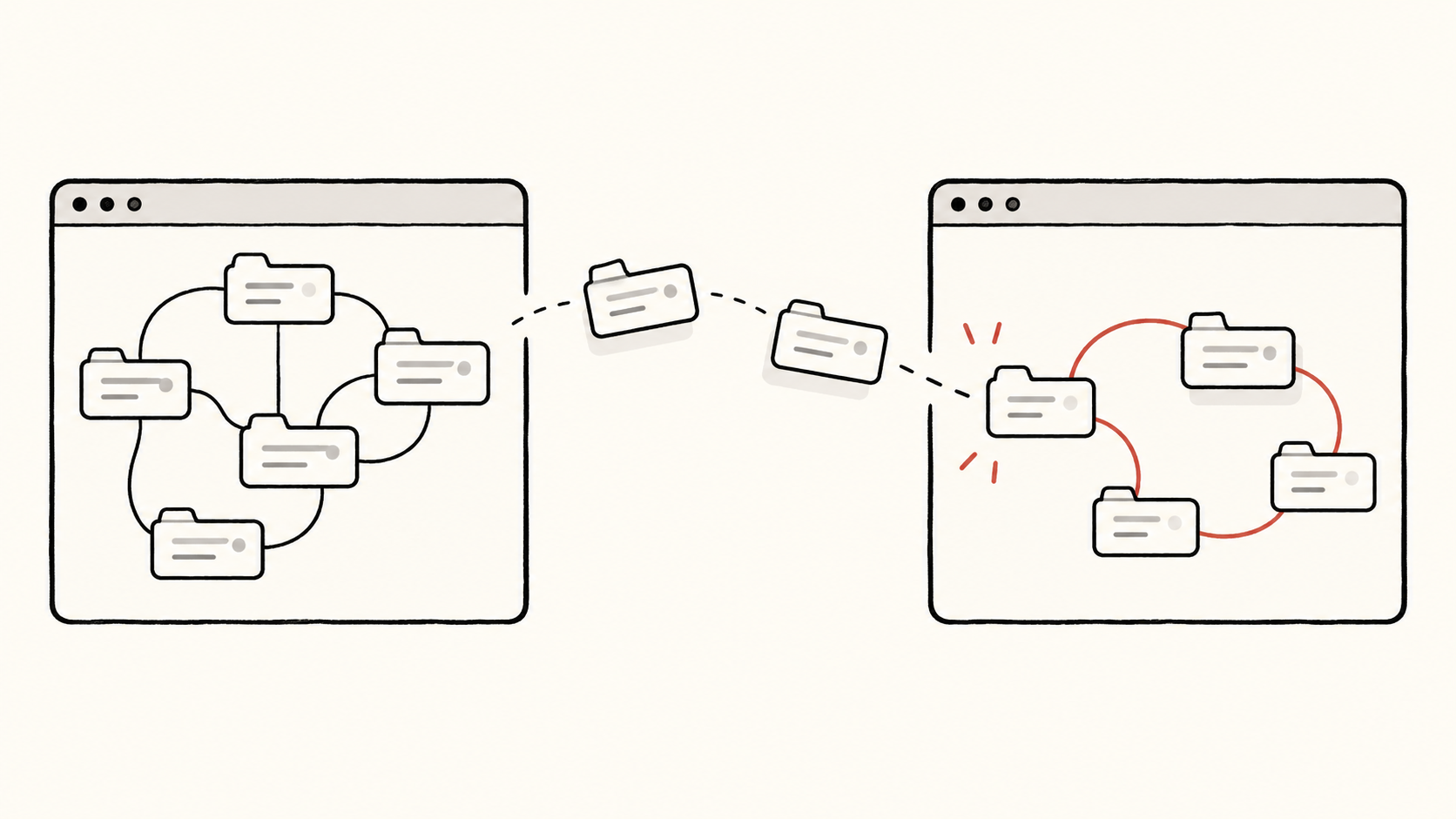
Arc’s October 22 announcement sets December 22, 2026 as its desktop shutdown date. It offers migration to Dia or a tab-link export for other browsers. Official announcement.
The practical question for someone who has built a working environment inside a browser is how much of that environment can be reconstructed. A successful export is evidence that some data has moved. To judge whether the move is usable, the person still needs to reopen the work and understand where to continue. This article develops that distinction as an editorial analysis, not as a benchmark of Arc, Dia or any competing browser.
The relationships around a link
Consider a hypothetical researcher comparing a company’s current disclosure with an older filing and a spreadsheet of assumptions. Each address can remain valid after migration. Yet the useful unit of work also includes which filing is current, why the older version was retained, which spreadsheet belongs with the comparison and which question is still unresolved. A folder name might encode some of this. The researcher’s memory might encode the rest.
A bookmark count cannot measure those relationships. Losing a disposable reading list and losing the context of an unfinished investigation can produce the same change in the count, but very different recovery costs. Conversely, a smaller collection can be more useful if obsolete duplicates have been identified and the remaining material has clear labels. There is no general reason to make exact numerical equality the acceptance condition.
The first migration decision should therefore concern what must remain intelligible. A person who mainly visits familiar sites may need little beyond reliable access. Someone managing several projects may need a short project index: what this group of resources is for, which document is authoritative and what the next step was. That index can live in an appropriate, access-controlled document rather than in a browser-specific visual arrangement. It need not become a second copy of every page.
A common format has a limited job
Google documents HTML bookmark import and export in Chrome. Chrome documentation. That provides a useful interchange route for this class of information. It does not, by itself, demonstrate that every field in a different product’s export is compatible, or that a complete project arrangement can be reconstructed from it.
This is a boundary worth keeping explicit. A file can be readable while an importer interprets only part of it. A destination can display every address while placing the collection in a structure that makes little sense to its owner. Neither outcome proves that the source product lost data. The issue may instead be the mapping between different organizational models. Identifying that mapping makes a remedy possible; simply reporting “migration failed” does not.
For an actual move, a small representative trial is more informative than immediately importing a very large collection. Include an active project, an older project that still matters and a resource used under a separate work identity. Verify what each trial is intended to establish. A link opening establishes reachability; it does not establish that the correct account or project context is in use. These are proposed checks, not claims that any named browser mishandles accounts.
Reopening yesterday’s work is the stronger test
A useful rehearsal starts with a task that the person recently completed and could recognize. Can they find the authoritative source, compare it with the relevant alternative and continue the next step without rebuilding the whole arrangement? Record where manual reconstruction was needed and whether the gap would matter during a busy day. A test that merely opens the destination’s home screen cannot answer those questions.
Selection matters more than a large sample of easy links. Several bookmarks to public news sites may all work while the one project requiring a specific account remains unresolved. At the same time, one exceptional project should not be treated as proof that every routine task is broken. Separate ordinary work from the exceptions, then decide what must be repaired before making the destination the default.
There is also a risk in repeated trial imports. Mozilla says Firefox adds HTML-imported bookmarks to existing bookmarks and that duplicates may result. Firefox documentation. An increase in the collection after a retry therefore deserves explanation rather than automatic celebration. Keep the source snapshot and the trial result distinguishable, and use the receiving product’s supported backup and recovery options before changing an established collection.
Convenience and independence can coexist
A migration path designed for a particular successor product may preserve more of a familiar arrangement than a broadly compatible export. That can be a rational choice when continuity is urgent. A more neutral representation can serve a different purpose: giving the owner something understandable outside one product’s interface. These approaches can complement each other, provided the neutral copy is actually tested rather than assumed to be sufficient.
Maintaining such a copy also has costs. It can become stale, create another place containing sensitive project links, and demand upkeep that a light browser user does not need. The sensible scope is the material whose loss of context would be expensive. Store it with access appropriate to the information it reveals; do not turn a migration exercise into an indiscriminate sharing or credential-export exercise.
The broader product-design implication is that portability should be described in terms people can verify. Vendors can distinguish transferred objects, preserved relationships and features that need reconstruction. Users can judge the result against their own work rather than a vague assurance of completeness. No documentation reviewed here establishes actual migration success rates or proves which destination will suit an individual. The remaining uncertainty has to be resolved by a real, bounded rehearsal while the original environment is still available.
The durable outcome is modest but valuable: the next time the interface changes, the owner should still know what the material means and how to resume the task.
Information only. No investment, legal, tax, or financial advice.