Box Architect’s real test: permission is not process correctness
Box links agent controls with workflow design, but exception handling, human approval and unit costs still need proof.
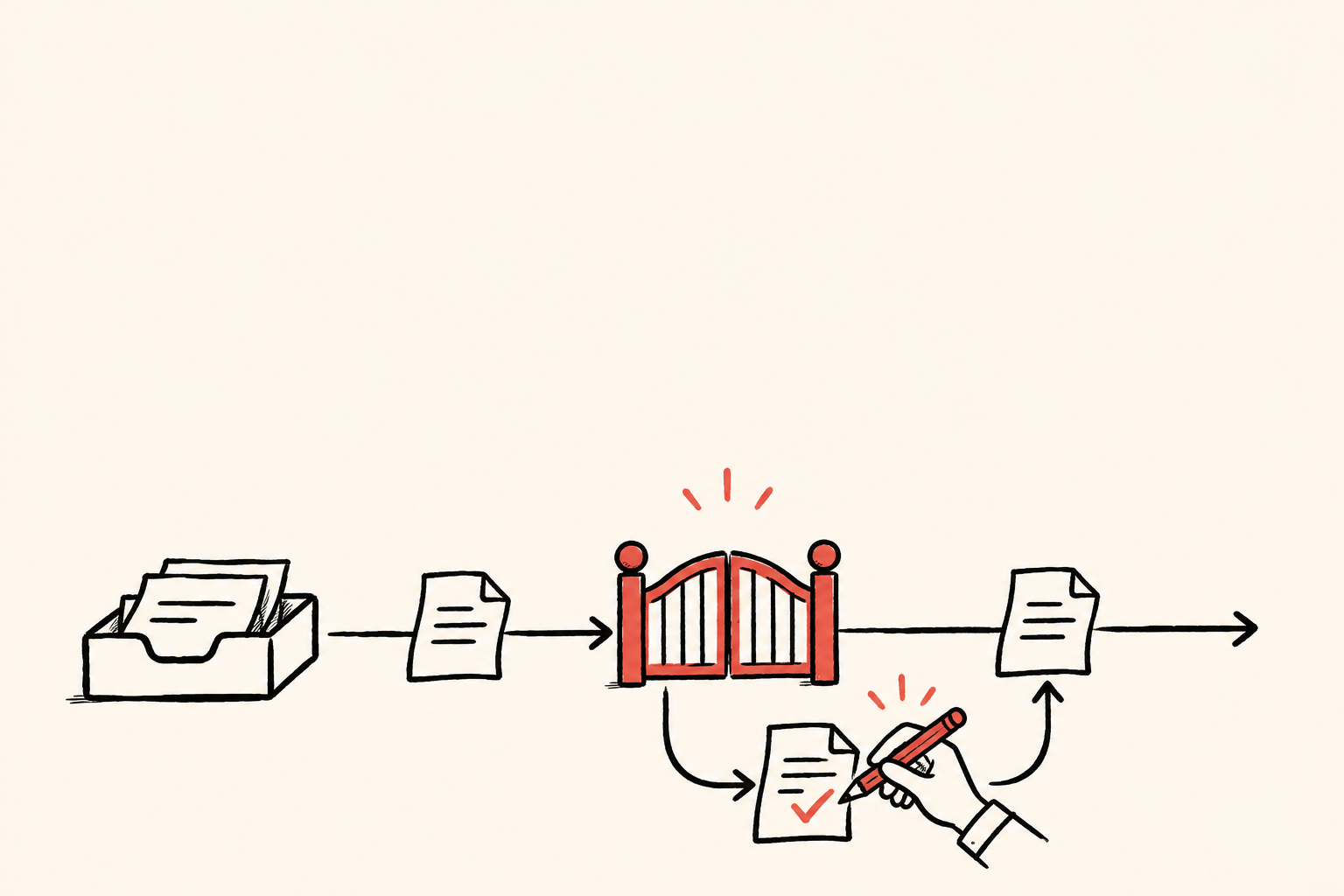
In its November 5 BoxWorks announcement, Box put different product states on the same roadmap. Agent security controls are generally available to Shield and Enterprise Advanced customers. Box Architect is planned for an Enterprise Advanced beta in Q4, while new threat protection is planned for early 2027. This is not an automation system that has already shipped in full. Box announcement
The important question is not whether a chat window can generate longer answers. It is whether a business can turn a natural-language description into a dependable execution process. What follows is analysis of the product design, not a test of unreleased features or evidence of customer returns.
From generating answers to assigning responsibility
Box describes Architect as a way to use an organization’s existing content and procedures to design, assemble and improve workflows. Its product explanation emphasizes testing real material and edge cases before deployment and adding human review at important decisions. Process owners would decide whether to adopt subsequent improvement recommendations. Product explanation
That expands the question from whether a model understands correctly to who is responsible at each step. A reader might catch a small mistake in a document summary. An incorrect decision inside a workflow can instead determine where documents go, the order of approvals and who sees the next set of materials. Errors can sit in the connections between tasks, not just in an answer. Connecting tools does not establish that the conditions for handing work between them are sound.
A business might require an application to be complete before review. But completeness could mean the right number of documents, or it could require valid versions, matching names and consistent fields. If that definition is unclear, automation merely executes an ambiguous rule more consistently. Buyers need acceptance criteria before they debate how quickly a workflow can be generated.
Permissions establish boundaries, not judgment
The available controls cover classification-based access, restrictions on MCP tool actions and alerts when activity crosses customer-defined thresholds. Box announcement These address which content can be reached, which actions can be taken and when activity should attract attention.
Permission to read a contract is not competence to interpret it. Permission to move a file does not mean the case satisfies the business conditions for advancing. Inheriting existing permissions matters, but it is not a certificate of process correctness. If a person already has broad access, an automated process running with that access may still have more capability than the specific task needs.
Evaluation should separate three questions: is access allowed, does execution follow business rules, and is the result reliable enough for its consequences? Passing the first should not automatically pass the others. For consequential decisions, human approval is a boundary of responsibility, not a decorative patch for insufficient intelligence.
The economics sit in the exceptions
Natural-language workflow creation could lower the initial configuration barrier. Total cost still includes preparing data, validation, repeat execution, human checking and maintenance. A clean demonstration cannot establish how much intervention a thousand mixed cases require. Without that evidence, a feature list cannot establish hours saved or improved profitability.
A useful unit is cost per correctly completed business case, rather than price per model call. A cheaper model that misses more fields, triggers retries or routes simple cases to specialists can become more expensive overall. Conversely, a more capable and expensive model should not automatically handle every mechanical step.
The approval queue matters too. If automation prepares material faster but sends every uncertainty to the same reviewer, the bottleneck moves from intake to review. Teams should track waiting time, rework, human handling minutes and reasons for exceptions together. Machine speed is not end-to-end efficiency.
Start with a narrow process, not a grand blueprint
A reasonable pilot has a clear scope, verifiable outcomes and recoverable errors. Keep a human-operated baseline, then run the candidate process on comparable materials. The test set should include missing pages, duplicates, conflicting information, obsolete versions and inputs that look complete but are invalid. Selecting only tidy examples defeats the purpose.
Acceptance is more than a success rate. Teams need to know when the system refuses to continue, when it requests more information, who receives exceptions, how completed actions are corrected and what happens when the same case is submitted twice. Clear stopping and recovery rules make expansion easier to assess than reliance on improvised rescues by staff.
Continuous improvement introduces another management problem: changed workflows need renewed evaluation. A suggestion may reduce average handling time while increasing risk for a minority of complex cases. Owners should know which version is running, why it changed and when it can be rolled back. Automatically proposing an improvement does not mean automatically approving a new business rule.
For Box, proving value is harder than displaying capability
Strategically, bringing content, permissions and workflow together could extend Box from storing and collaborating on files into executing everyday work. That is an analytical opportunity, not a realized revenue conclusion. Adoption, willingness to expand paid usage and manageable maintenance costs require evidence after delivery.
The most useful future disclosures would go beyond agent counts: how many processes move from pilot to stable operation, how many cases finish without rework and how human review and total costs change as usage grows. Delivery milestones also need separate tracking. Available controls can be evaluated now; the Architect beta and subsequent threat protection need their own verification.
The roadmap touches the central tension in enterprise AI: giving systems more actions requires making responsibility, limits and correction more explicit. Progress is not removing the approver from the diagram. It is ensuring each step knows when it may proceed and when it must stop.
Information only. No investment, legal, tax, or financial advice.