Where BigCommerce’s storefront shopping agent should stop
A storefront assistant needs reliable product evidence and a clear checkout handoff, not just fluent conversation.
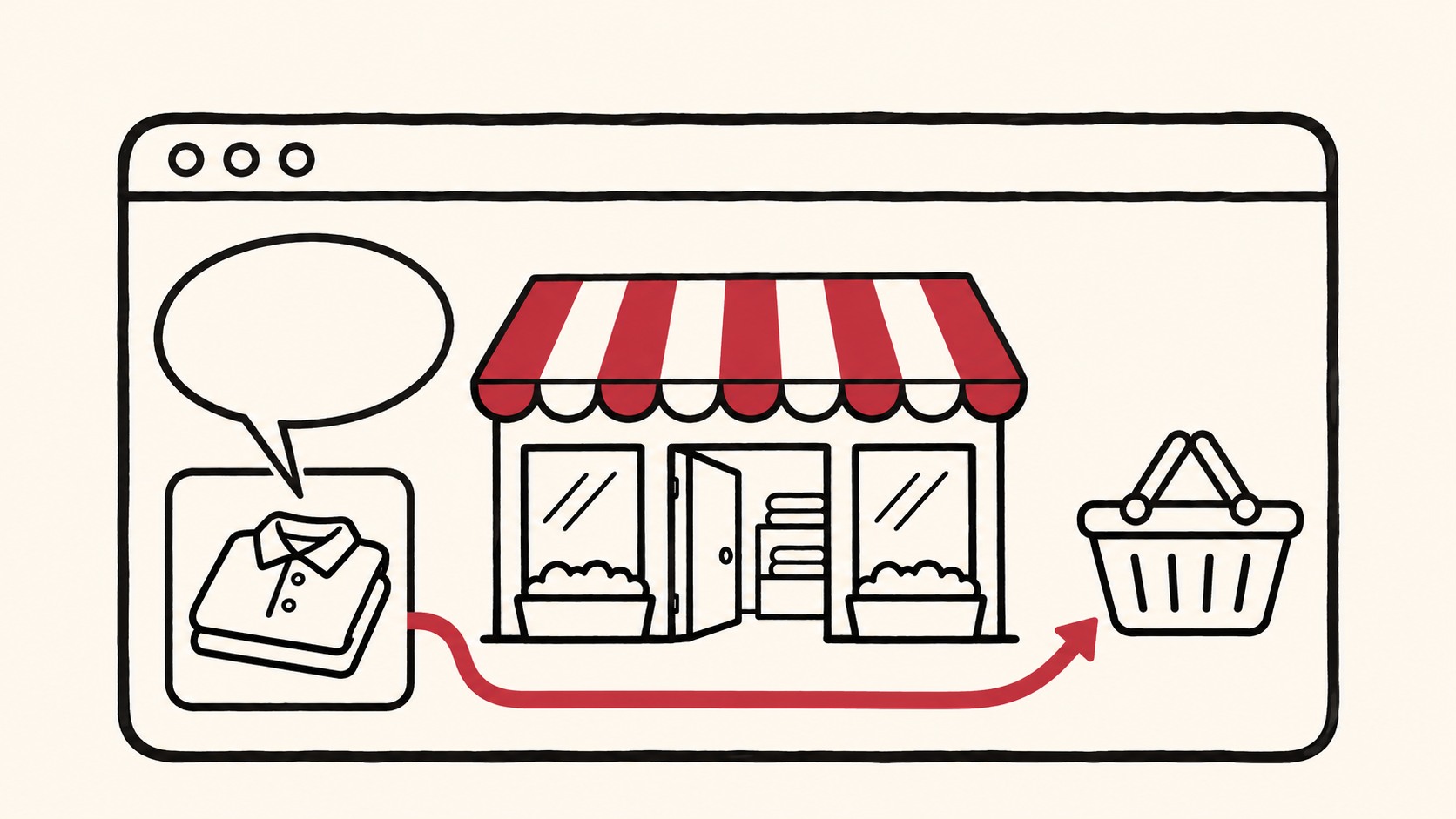
On November 16, Commerce.com began rolling out Shopping Agent to eligible BigCommerce merchants. The broader availability of conversational storefront search across paid plans should not be confused with eligibility for the agent itself. Launch announcement
The interesting question is not whether a store now has another chat window. It is how much purchasing guidance can remain inside the merchant’s storefront, and where that guidance must give way to product records and an explicit purchase decision. What follows is an evaluation framework, not evidence of higher sales.
A conversation is not a completed transaction
BigCommerce’s product page states the boundary clearly: the assistant can add items to a cart and direct shoppers to the merchant’s checkout, but does not process payment in the conversation. Product details
“Help me choose” and “I agree to pay” should remain distinguishable events. The first allows questions, comparisons and changes of mind. The second concerns a particular variant, quantity, amount and order status. Keeping the storefront and checkout does not make every conversational promise an order term, or remove technology providers from data processing. Brand presentation, transaction responsibility and data permissions need separate scrutiny.
The handoff is more than a button. Suppose someone first requests a medium black item, then changes to large blue. The recommendation and actual cart must agree. A failed cart update must not be described as successful. New shipping charges or inventory changes at checkout must remain visible rather than disappear behind an earlier conversational summary.
External discovery is a different job
Amazon’s Shop Direct offers a useful comparison. Its ordinary route sends shoppers to the merchant’s website; eligible products may instead support Buy for Me after customer confirmation. These are different purchase paths. Amazon’s explanation
External discovery and an in-store assistant can coexist. The former influences where a shopper encounters the shortlist. The latter helps someone already visiting a store choose. Even when both produce orders in the merchant’s systems, the external recommendation surface is not controlled by the merchant. Conversely, a better on-site conversation cannot automatically create missing traffic.
Interfaces and connection tools also need separating. BigCommerce’s WebMCP documentation describes browser agents using store tools to build a cart, with shoppers completing checkout on the site. It is not another name for Shopping Agent. Developer documentation A merchant should map who initiates the request, reads the catalog and changes the cart, and where the customer resumes control. “AI shopping enabled” answers none of those questions.
Product evidence matters more than polished descriptions
Consider a hypothetical commuter-bag store. A shopper wants rain protection, room for a particular laptop and delivery before Friday. Those conditions involve intended use, internal dimensions, variant availability and delivery commitments. These are proposed test cases, not allegations of product failures.
If the catalog contains only external dimensions, the assistant should not infer laptop compatibility. Availability of another color cannot stand in for stock of the selected variant. “Suitable for rainy days” must not become an undocumented waterproof certification. Friday delivery requires evidence for the relevant destination and service, rather than a generic promotional line.
Merchants therefore need to identify an authority for each fact: the catalog record behind a specification, the cart calculation behind a price, and the effective policy behind a promise. Information need not live in one database, but conflicts need an explicit resolution rule and someone responsible for corrections. Connecting stale content to a more articulate assistant can make errors more persuasive.
Inspect wrong orders before celebrating conversion
A small pilot could cover common questions and a few complicated products, while preserving the existing shopping route as a comparison. Within similar traffic sources, devices and promotions, measure appropriate product selection, correct cart additions and completed payments separately. A click is not an order.
Track human support handoffs, variant corrections, cancellations and return reasons as well. An assistant might accelerate good purchases or merely postpone explanatory work until after the sale. Immediate conversion alone cannot distinguish the two. Comparing chat users with all visitors also leaves selection bias: people asking questions may already intend to buy.
Acceptance testing should include missing compatibility data, changing prices and delivery requests that cannot be guaranteed. The best response may be to identify the information gap and direct the shopper to a useful page or person, rather than continue recommending. Necessary pauses should not be sacrificed for conversational smoothness.
The confirmed development is a rollout to eligible merchants, not universal access or proven conversion gains. Before purchasing, merchants still need to establish their eligibility, charges, supported scope, record retention and exit arrangements. A storefront agent earns its place when it reduces shoppers’ verification work without transferring a larger burden to the order team.
Information only. No investment, legal, tax, or financial advice.