Regional model retirement does not authorize every fallback route
A replacement model needs workflow-level acceptance tests, not just a working API and fluent answers.
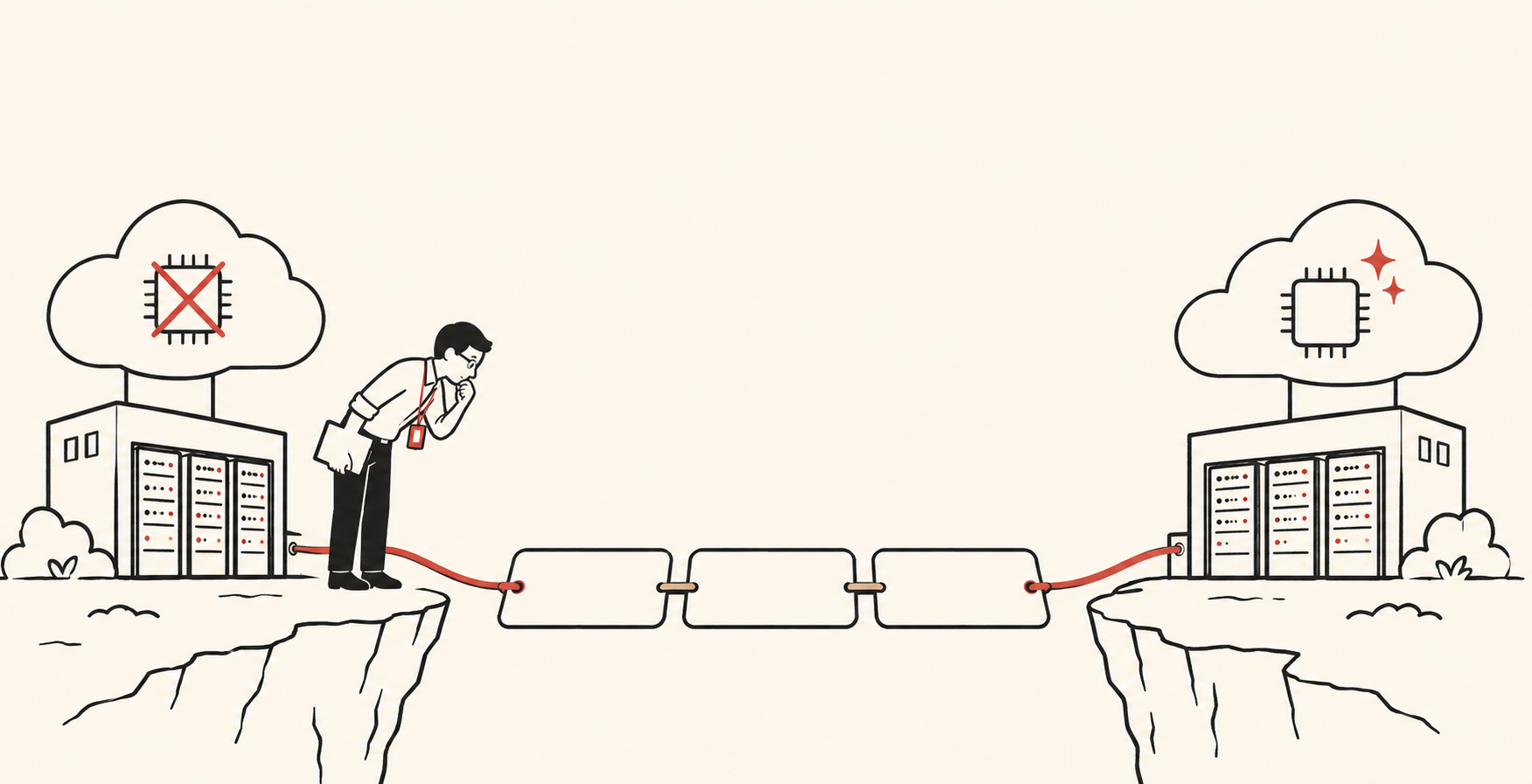
November 13, 2026 is an AWS-listed end-of-life date for older Claude versions in certain regions, not a worldwide shutdown. Scope is defined in the AWS regional table. The consequential question is not merely which model comes next, but whether a company's promises to customers survive the change.
This is Open Market Notes analysis, not a report of an actual customer outage. Our argument is that the unit of acceptance should be the business workflow. A successful API response, more fluent prose or a better public benchmark score cannot independently establish that a production system is ready to switch.
Regional differences do not authorize an automatic detour
Availability elsewhere is not sufficient grounds to move a workflow there. Our analysis is that a region change also changes conditions requiring validation: internally approved data-processing locations, network paths and available capacity. An identical model name cannot substitute for those checks. For a workflow with explicit data boundaries, temporarily narrowing automation may be preferable to treating unapproved cross-region processing as a harmless technical adjustment. Incident owners need to know which alternative route has actually passed internal review and which remains an architectural idea.
Better answers and authorized actions are different tests
Consider a hypothetical retailer's assistant that explains return policies and prepares support tickets. An older model escalates ambiguous clauses; a replacement produces more complete explanations. That may improve the experience, but it may also turn an unconfirmed exception into an apparent customer entitlement. This is an illustrative scenario, not an observed incident.
The migration team must distinguish advice from outputs that initiate refunds, alter orders or communicate externally. For consequential steps, correct prose is only one requirement. Tool arguments, customer identity, authorization conditions and failure handling also need examination. A model could improve ordinary answers while remaining unsuitable for the existing degree of autonomy on a small number of high-consequence tasks.
Historical performance is therefore useful evidence. What deserves preservation is not attachment to a version but business-approved examples, error categories and escalation rules. Without these, demonstrations become a substitute for testing, and customer complaints become the first meaningful acceptance exercise.
Inventory the actual service, not the brand
Anthropic's documentation distinguishes its own platforms' retirement schedules from partner-operated platforms. An enterprise inventory should therefore identify the actual invocation path rather than simply record that the organization uses Claude.
We would put the workflow owner, deployment region, version, access route and fallback in one maintained record. This does not imply that every company needs multiple providers. A small team can first identify affected processes, decision deadlines and the automation it will suspend if migration is not ready.
Two providers do not automatically deliver continuity. A backup lacking the necessary business context, or producing output that downstream software cannot accept, merely moves the failure. Additional routes also create permission, data-handling and monitoring work. The economic case for redundancy depends on interruption costs versus maintenance costs, not the number of boxes on an architecture diagram.
Measure the cost of a completed task
AWS evaluation documentation describes custom datasets, human evaluation and model-based scoring. Those tools do not decide which mistakes a business can accept.
For the hypothetical support workflow, appropriately de-identified historical cases could be separated into routine questions, policy boundaries and cases requiring a person. The first group tests correctness and speed; the second tests the handling of uncertainty; the third tests whether automation stops when it should. This is our suggested design, not an AWS-prescribed standard or a claim to cover every risk.
Costs should likewise be measured across a completed task. A cheap invocation is not necessarily a cheap ticket if employees must rewrite the output or failed attempts trigger repeated work. Conversely, higher inference spending may be justified by less rework. Public price lists alone cannot settle that question without the company's own samples and labor data.
Rollback may require a different service
Restoring an old configuration is not a complete contingency plan when the old dependency is unavailable. A useful degraded mode might return retrieved material without generated advice, require human approval for actions, or temporarily narrow the service. These options sacrifice convenience while retaining clearer responsibility.
The NIST AI Risk Management Framework is voluntary risk-management guidance, not product certification. Our further inference is that migration acceptance belongs jointly to business, engineering and operations, rather than solely to the engineer changing a model identifier.
Regional schedules and individual arrangements can differ. We do not infer that a particular company has suffered an outage, or recommend a universal replacement. The durable objective is to treat models as changing dependencies while keeping verifiable business commitments under the enterprise's control. The next retirement then becomes an evidence-backed change, not another guess about system reliability.
Information only. No investment, legal, tax, or financial advice.