AWS gives inference one endpoint. Failover still needs headroom per model
AWS can reroute inference across regions. The real test is how much model capacity survives, how long requests wait, and how many streams finish.
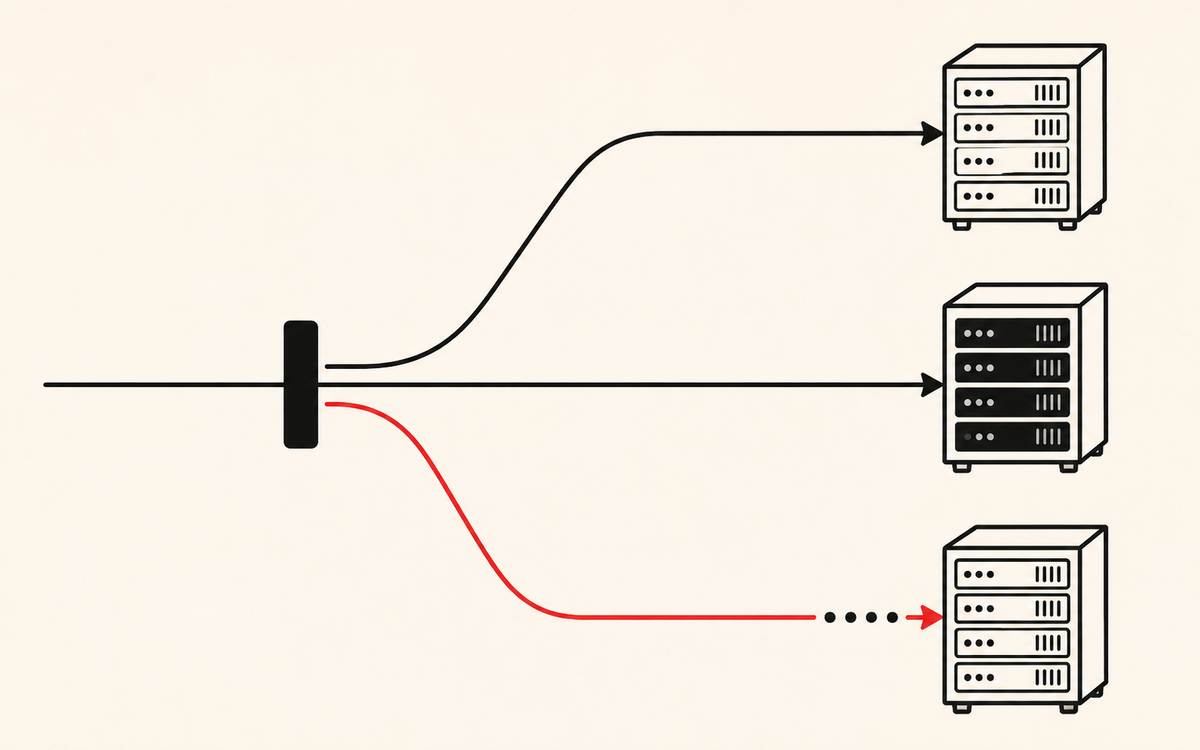
On November 20, AWS introduced the Amazon SageMaker HyperPod Global Inference Gateway and said it was available in 13 AWS Regions. It adds a tier above the in-cluster gateway announced in September. An application calls one HTTPS endpoint in a chosen Region; the managed gateway picks a cluster and the local gateway picks a model-serving pod. A cluster must be registered, enabled and able to serve the requested model. Bagelcode, quoted by AWS, described an earlier two-Region beta test in which traffic kept flowing after a cluster could no longer serve the model. The report does not quantify peak-load recovery time, remaining capacity or end-to-end latency. It cannot establish a production service objective.
Idle hardware may not back up this model
The denominator for failover is the capacity that can actually serve the same model in permitted Regions, not the total GPU count. Consider a hypothetical service. Regions A and B normally handle 70 and 30 requests per second for one model; B can handle at most 60 within the latency target. If A stops serving, the endpoint can still accept traffic while B is short 40 requests per second of capacity. Synchronized retries can raise the load further. These are illustrative numbers, not AWS measurements. A capacity test must reproduce the mix of short and long prompts, output lengths, concurrency and warm versus cold caches. A batch job might afford to wait when a synchronous customer-support window cannot.
Model revisions, tokenizers, authorization and resource limits can differ across Regions. Identical model names establish a routing relationship; teams still need to verify equivalent output contracts and access controls. Where residency matters, restrict the eligible cluster set. AWS measures proximity from the gateway's Region, not from the end user. It is a scoring input, not a data boundary. AWS documents a gateway with members from only one Region when local processing is required.
Count retries and broken streams separately
AWS documents a bounded failover, not unconditional replay. Certain connection and upstream failures can be retried once on another member. The gateway does not resume a response that has begun streaming. Where no healthy member serves the model, the gateway may return 503. The guide also separates member-region loss from failure in the gateway's own Region. Spreading model deployments across Regions does not establish a cross-Region fallback for the front door itself. In a staging environment, remove one member for a model, make a member Region unreachable, and separately simulate a client that cannot reach the ingress Region. The last case tests whether the application needs a separate ingress and switching policy; it is not a report of an AWS incident.
Record client-observed p95 and p99 both for time to first usable token and time to a complete response. Split results by model, caller Region, serving Region and request length, and track timeouts, 429s, 503s, truncated streams and retries separately. A chart based only on requests that returned a first token can improve when the worst requests fail altogether. One useful service measure defines a good request as a complete response delivered within its deadline and counts every eligible original request in the denominator. Record retry count, added latency and load independently rather than counting the second attempt as a second user. In applications that call tools or write data, make retries idempotent: a disconnected stream does not mean no action ran.
Let the error budget set the reserve
Suppose an internal monthly objective is 99.9% complete and timely delivery. One million eligible requests allow 1,000 misses. A ten-minute failover in which three requests per second time out or truncate spends 1,800 misses, exceeding the month's allowance even if the other requests eventually complete. That is a measurement example, not an AWS SLA. Compare the same workload under local routing, cross-Region overflow and failover; then decide whether to reserve capacity for critical models, throttle lower-priority batch work or separate ingress endpoints. One hostname reduces configuration. How much service survives still depends on model-ready capacity, network distance and the client deadline.
AWS November launch post · AWS Developer Guide · AWS September per-cluster launch
Information only. No investment, legal, tax, or financial advice.