Cheaper AI inference needs a deadline budget, not just a GPU discount
AssemblyAI’s compute savings raise a broader question: how much delay and recovery work can an AI service afford?
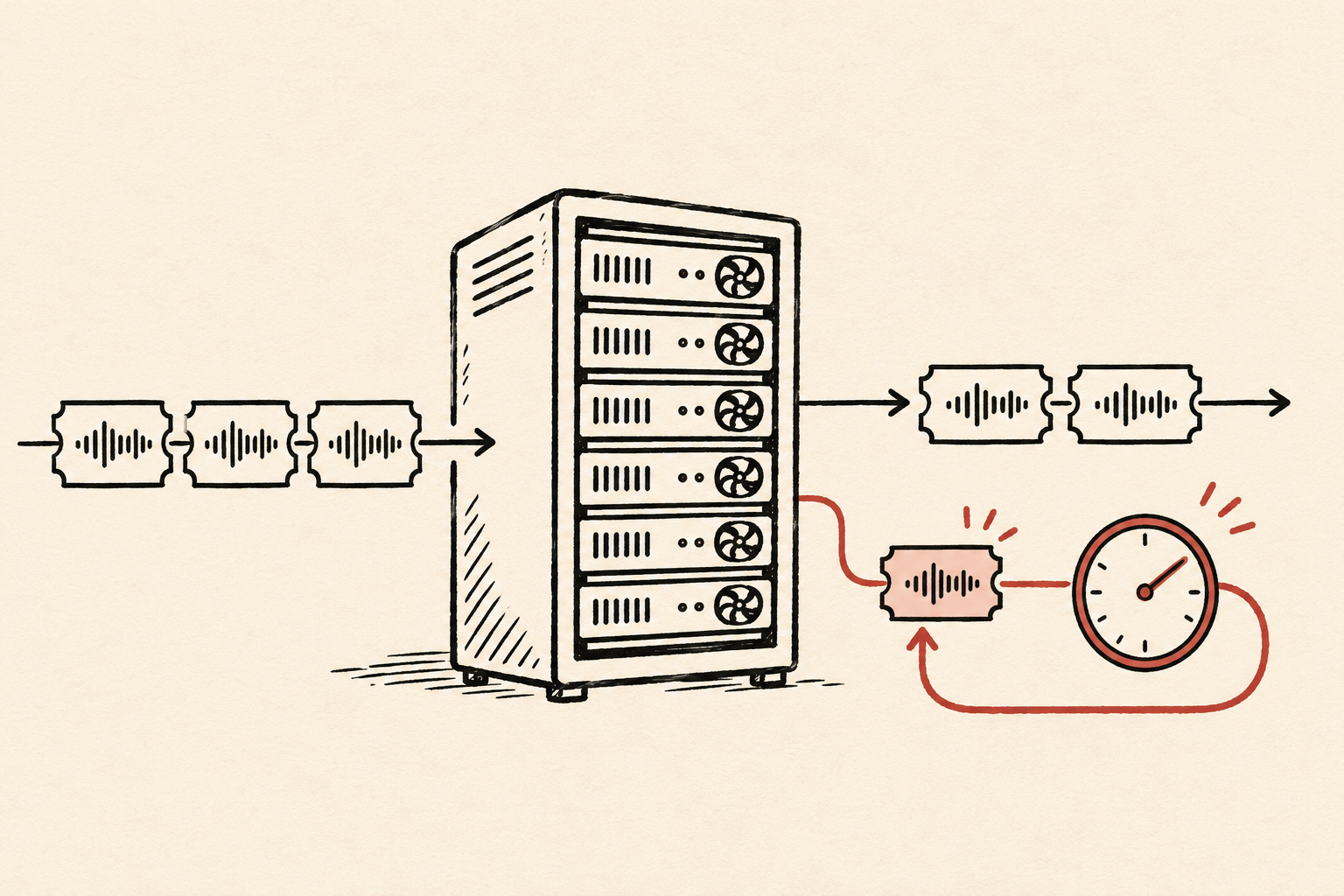
AWS’s case study dated 13 November 2026 reports AssemblyAI inference-compute costs 70% below On-Demand pricing. This is a compute comparison, not a disclosure of company-wide margins. Original case study
The interesting question is not whether a discounted GPU is cheaper. It is whether a service can turn that discount into more completed, useful work without missing the moment when its customer needs the answer. The following is Open Market Notes’ analysis of that trade-off, not an audit of AssemblyAI’s accounts or a reconstruction of its internal operating metrics.
A lower price does not define a lower unit cost
A hardware bill purchases time. A customer purchases a result. Between those two units sit idle capacity, model loading, failed attempts, storage, network transfers, monitoring and engineering. Counting only successful machine-hours hides some of the work required to make those hours productive; counting every API response can hide unsuccessful or late results.
For an asynchronous transcription service, a useful economic unit might be an audio minute processed correctly and delivered within the promised window. A team would need to agree on what “correctly” and “within the window” mean before calculating savings. A lower bill accompanied by a growing backlog is not automatically a more efficient service. It might simply be a service doing less of its promised work on time.
Consider a hypothetical business, not AssemblyAI: compute represents half of its fully loaded delivery cost. If that component falls by 70% while every other component stays constant, total delivery cost falls by 35%, not 70%. Added recovery work would reduce the gain; better utilization could improve it. This arithmetic does not predict any company’s result. It explains why the denominator matters before a case-study percentage enters a budget or an investor presentation.
The customer’s deadline determines the usable discount
AWS documents two-minute notices for Spot stopping or termination, issued on a best-effort basis; hibernation does not offer that advance window. A warning is therefore not an unconditional recovery guarantee. Interruption documentation
A job is economically flexible only if its remaining time budget can absorb failure detection, reassignment, startup and execution. Finishing a recording overnight and responding in a live conversation are different promises even if both use speech models. A backup that eventually completes the first job might be useless for the second.
This suggests separating jobs by their delivery obligations, rather than treating all inference as interchangeable demand. A time-sensitive queue may justify more expensive capacity. A flexible queue may tolerate delayed execution. But moving a job to the flexible queue should not quietly weaken a promise already sold to a customer. Product packaging, scheduling and cost accounting have to describe the same service.
The critical measurement is often the slowest meaningful share of requests, not the average. An acceptable average can coexist with a small group of customers repeatedly waiting too long. Teams should examine end-to-end completion-time distributions and deadline misses together with spending, rather than optimize one chart and inspect reliability only after complaints arrive.
Recovery must preserve the result, not merely restart the worker
SQS standard queues can deliver a message more than once; AWS advises idempotent processing. Delivery semantics Its visibility timeout temporarily hides received work, and undeleted messages can reappear when the timeout expires. Visibility documentation
Our implication is operational: a retry needs a stable job identity and a clear rule for accepting the final result. Otherwise two workers can turn one request into conflicting outputs, repeated notifications or duplicate charging. The queue alone does not define the business meaning of “done.” A durable completion record and a defensible billing rule are part of the service design, not cosmetic administrative details.
There is also a boundary between rescuing work and endlessly repeating it. A damaged input may fail on every machine. Retrying it consumes capacity needed by healthy jobs while making the backlog look like additional customer demand. Recovery decisions should distinguish temporary capacity loss from work that requires investigation. This is a design recommendation, not a claim that AssemblyAI has encountered these failures.
Capacity is a portfolio of delivery options
AWS’s price-capacity-optimized strategy considers available capacity before choosing cheaper pools; lowest-price-only selection carries greater interruption risk. Allocation documentation Its queue-scaling guidance relates backlog to running capacity and acceptable latency, rather than queue length alone. Scaling guidance
For an operator, a spare machine is valuable only if it can execute the model and meet the deadline. Nominal instance counts can conceal different throughput or startup costs. Supporting more hardware options also introduces testing and maintenance work. Diversification is worthwhile when the additional delivery options exceed that complexity, not merely because a diagram contains more boxes.
The same reasoning changes how a service should assess an incident. A temporary rise in the share of expensive capacity may be the correct response to protect promised delivery. Penalizing that rise in isolation could encourage a team to preserve its cost target by accumulating overdue jobs. A better operating review asks what was delivered, what failed, what was retried and what each outcome cost.
AssemblyAI’s reported saving is a useful prompt to examine inference economics. It is not a universal discount that another business can insert into its forecast. The more transferable question is how much recovery and delay a product can absorb while still delivering what it sells. That answer belongs to the service’s contract with its customers, as much as to its choice of GPU.
Information only. No investment, legal, tax, or financial advice.