Arete makes model values adjustable. Who checks the evaluator?
Open weights enable different choices, but agreement with an evaluator is not the same as reliable judgment.
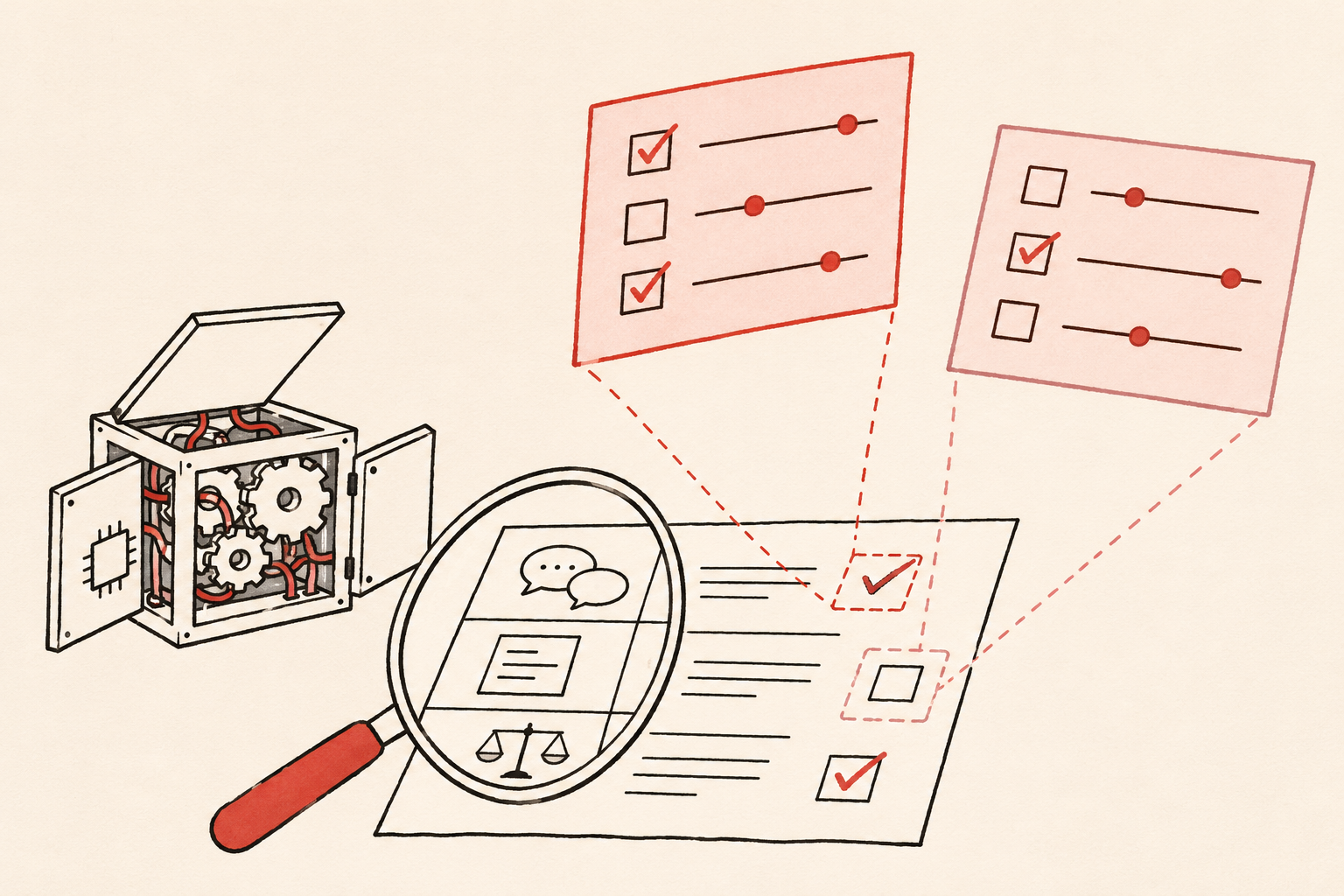
Nous Research’s Arete repository records a November 6, 2026 release. The developer describes the Qwen-based model as a change in value orientation. That is a development objective, not independent proof of neutrality. (Release history, announcement, model card)
The important question for an organization is not simply whether it prefers the new answers. It is whether it can explain what improved, which disagreements remain legitimate, and what evidence would make it reverse its decision. This article offers an editorial framework for that assessment. We have not run or independently evaluated Arete.
Agreement is not a single measure
A model can supply a correct date while presenting a selective account of why an event happened. It can also challenge a question’s premise without being unhelpful. Treating both situations as a single impression of quality makes it difficult to distinguish better evidence from a more agreeable voice.
Consider a hypothetical research assistant comparing two public policies. One answer accurately identifies their costs but omits an important affected group. Another includes that group but invents a statistic. A third gives no recommendation because the available evidence cannot establish causation. These are different outcomes. The first has a coverage problem, the second a factual error, and the third may be appropriately cautious. A preference ranking alone does not tell an editor which repair is needed.
Nous’s published evaluation contains English questions and separates required factual content from framing judgments. The existence of those fields is useful for inspection, but it does not settle the validity of every judgment. (Evaluation dataset)
An organization should therefore decide in advance which propositions can be checked against records, which conclusions depend on interpretation, and which choices express its own service policy. It should not quietly treat the third category as evidence for the first. Naming a preference makes it more accountable; concealing it inside a general accuracy score does the opposite.
A test must allow its owner to be wrong
A demanding evaluation includes cases where the preferred answer is incomplete. Suppose an internal summary says a policy caused a business outcome, while the supplied document establishes only that both occurred in the same year. A useful assistant should preserve that distinction even when its correction is inconvenient to the person requesting the summary. This hypothetical test measures discipline around evidence rather than support for a particular policy.
The evaluator needs the same discipline. Reviewers should record the passage supporting a factual judgment and allow a reasoned appeal when an answer uses different but equivalent language. They should distinguish a disagreement about evidence from a disagreement about what matters. Otherwise, a model that learns the evaluator’s preferred vocabulary may look better without becoming more dependable.
There is a practical trade-off. Fully open test questions help others inspect judgments, while fresh, withheld questions help check whether improvement extends beyond familiar material. An organization can use both: a public set to explain the standard and a separately maintained set to challenge it. Neither should be represented as a certificate that every future answer is sound.
Review need not force complete agreement. Factual claims require clear support; trade-offs between goals can retain minority judgments and their reasons. Keeping a dispute visible is more informative than making it disappear inside an aggregate score. A later user can then understand which compromise the organization accepted, rather than assume there was only one possible answer.
Translation can change the decision being tested
A multilingual deployment requires more than translating an English prompt. A phrase can express a legal category in one language and a broader social judgment in another. If the translated question changes the standard, a different answer does not necessarily demonstrate inconsistency.
A better comparison starts with the underlying claim and its evidence. Local reviewers can check whether each version asks the same question, preserves uncertainty and keeps attribution intact. A model should be able to report an institution’s position without adopting it. It should also be able to identify an unsupported claim without assuming that all disagreement is misinformation. Those boundaries require examples and human review, not merely a multilingual average.
A hypothetical cross-border support case illustrates the distinction. When a customer asks why a restriction applies, the assistant should separate the document’s wording from the provider’s interpretation. Translating “the provider’s current interpretation” into “the law has established” makes the answer sound firmer while making the information worse. That is not simply a question of value orientation.
The deployment decision should stay reversible
A change that improves one class of answers can still be a poor substitution for a particular workflow. A team evaluating a new model should retain tests for its ordinary work: extracting a contractual condition, respecting a confidential field, citing the relevant passage, or declining to fill a gap with an invented fact. These are proposed checks, not claims that Arete succeeds or fails at them.
The NIST AI Risk Management Framework is a useful general reference because it places trustworthiness within the design, use and evaluation of AI systems. It is voluntary guidance, not an endorsement of this model. Our narrower recommendation is to connect the adoption decision to a recorded use case, named reviewer and rollback condition.
Open weights make it possible for different organizations to make different choices. That freedom is valuable precisely because a single institution need not determine every deployment’s priorities. But the organization making the choice must still distinguish its preferences from demonstrable facts. The strongest result would not be a model that always agrees with its buyer. It would be a system whose errors, disagreements and limits can be inspected before they become decisions on someone else’s behalf.
Information only. No investment, legal, tax, or financial advice.