AI deployment testing needs its own GPU capacity budget
AICR’s testing boundary raises a practical question about the production work displaced while gathering release evidence.
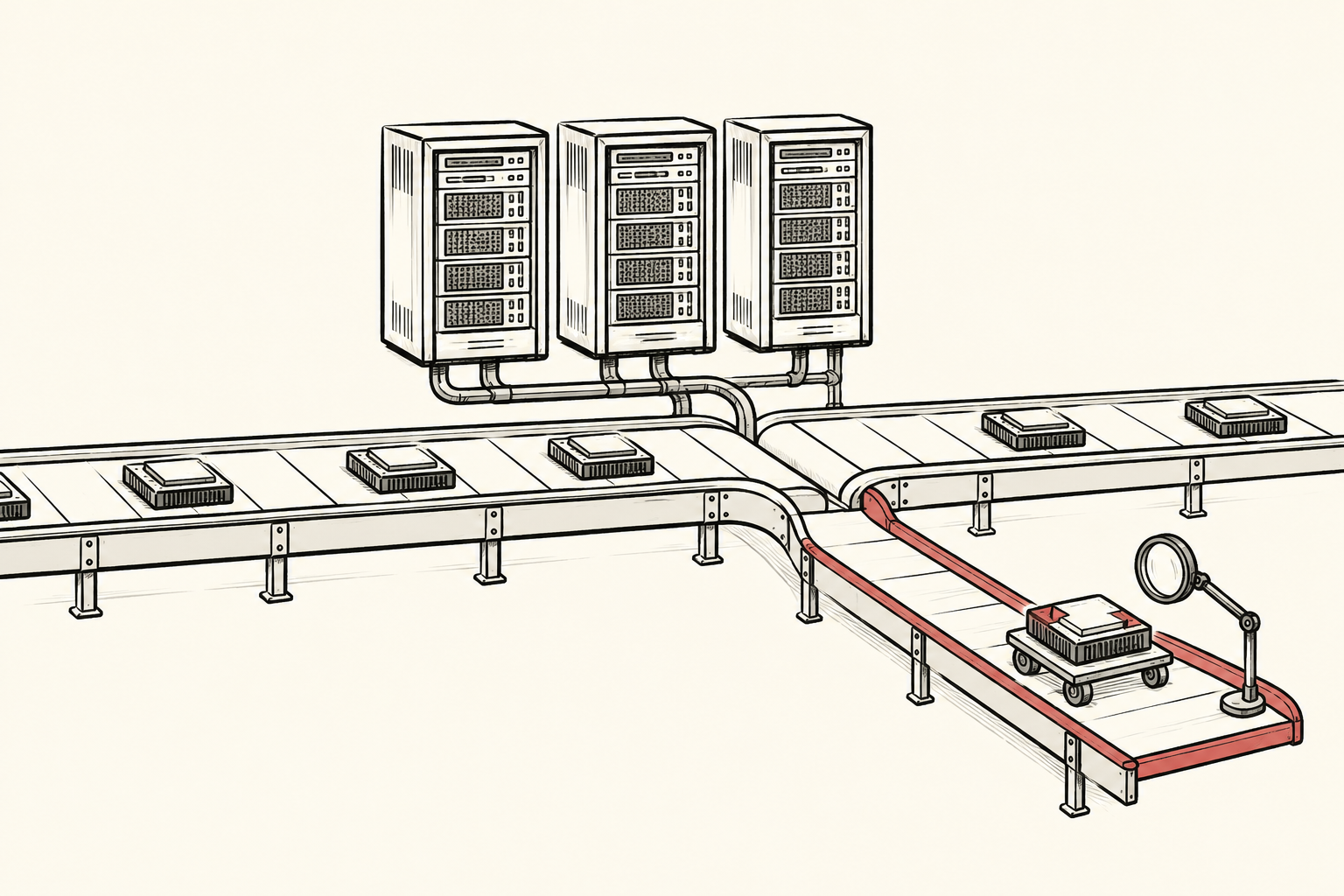
NVIDIA’s October 30, 2026 AICR tutorial separates conformance checks from performance tests that occupy GPUs. That detail raises a practical budgeting question: where does the capacity for proving a deployment come from?
This article’s analysis concerns that question, rather than estimating NVIDIA customers’ savings. The public tutorial does not establish an independently measured production return. A repeatable deployment can make investigation easier, but its commercial value still depends on the work displaced while testing and the uncertainty removed before release.
Testing has a place in the capacity plan
A platform team can book the same accelerator twice on paper: once as available production capacity and again as a convenient resource for testing its next version. Both plans may look sensible in isolation. The conflict appears when a release must be evaluated while demand remains high. Treating validation as an unpriced engineering activity conceals this conflict until the operating schedule exposes it.
Consider a hypothetical service that reserves a small GPU pool for candidate configurations. This creates an explicit cost: those machines cannot simultaneously serve its ordinary workload. It also buys a useful option. The team can examine a change without first negotiating an emergency interruption of production. That option may be valuable even when most tests find no defect, because the reservation reduces the time needed to obtain evidence when a consequential change arrives.
The comparison should therefore include the cost of maintaining a test environment, the production work deferred during shared-cluster tests, and the cost of postponing a release. None of these can be inferred from a successful installation. Nor is there a universal percentage of accelerators that every organization should reserve. A business with a steady workload and rare releases faces a different trade-off from one that frequently changes models and serves highly variable requests.
The budget also extends beyond the purchase date. Owning a machine does not make testing with it free. A reserved window might otherwise handle customer work, or it might have no competing use. Only the actual schedule distinguishes incremental expenditure from opportunity cost and helps avoid counting the same loss twice.
A cheaper test can answer a narrower question
A small isolated pool is easier to schedule, but it may omit the interference that makes a production decision difficult. Conversely, a full-scale trial can capture more interactions while consuming more resources and creating a larger operational exposure. The choice is a question of which uncertainty matters for the pending decision, rather than a contest to run the largest benchmark.
Kubernetes documentation describes readiness probes as controls for accepting traffic. That narrow role helps clarify the evidence a reviewer needs. A service admitted to traffic has crossed one operational threshold; a proposed customer commitment requires a separate argument about the workload and conditions under which that commitment is credible.
For the hypothetical service, a preliminary trial might examine whether the candidate can handle representative requests without changing application behavior. A later comparison could examine how it behaves alongside other services. If the production decision depends on coexistence, an isolated result should not quietly become the final acceptance evidence. The report should name the question left open, so that saving GPU time does not merely transfer uncertainty to the launch team.
That makes “insufficient testing” a claim requiring detail. Is a business request category missing, is a competing workload absent, or is a longer observation unfinished? Each gap calls for different additional work. Without that distinction, teams can argue between rerunning everything and releasing immediately without specifying what another hour of testing would change.
Preserve the denominator when comparing releases
NVIDIA’s benchmarking documentation reports throughput alongside latency and request concurrency. An editorial implication is that a release comparison should retain the workload conditions as well as the headline outcome. Otherwise, a faster result may reflect an easier trial, while a slower result may reflect more demanding coverage.
The useful record is a comparison that another team can interpret: what work was attempted, which configuration was tested, which demands were held constant, and where the trial differed from the intended service. This need not become a large compliance exercise. A concise explanation of the most consequential difference can be more useful than an impressive report that leaves the production assumptions implicit.
Google’s SRE discussion of overload cautions that requests can have different resource costs. That supports using multiple relevant workload cases, rather than treating an undifferentiated request count as the entire capacity story. Our further inference is that the testing plan should be revisited when the business changes what it asks the system to do, even if the deployment recipe itself has not changed.
Older results can still be useful, but their business assumptions should remain visible. Changed conditions do not make all earlier evidence worthless. Equally, an unchanged configuration identifier cannot extend a conclusion indefinitely. The task is to identify what changed and obtain the additional evidence that change warrants.
Decide what evidence is worth delaying work for
There are reasonable competing approaches. Dedicated test capacity offers scheduling certainty; borrowing capacity can be economical when usage has predictable gaps. A representative production trial may be justified for a consequential change, while a smaller preliminary test can reject an unsuitable candidate sooner. The important decision is not to declare one approach always superior, but to identify who bears the delay and who accepts the unresolved risk.
A useful release proposal can make that choice visible: it asks for a bounded test window, explains the decision the result will inform, and specifies the consequence of an inconclusive outcome. This does not guarantee safety or a return on infrastructure spending. It gives management a clearer basis for comparing additional evidence with the production work forgone to obtain it. Validation therefore belongs in an operating budget as well as in an engineering workflow.
Information only. No investment, legal, tax, or financial advice.