After AI finds the footage, who decides it can be used?
Video search should be evaluated by the work needed to verify and use a shot, not just the speed of finding it.
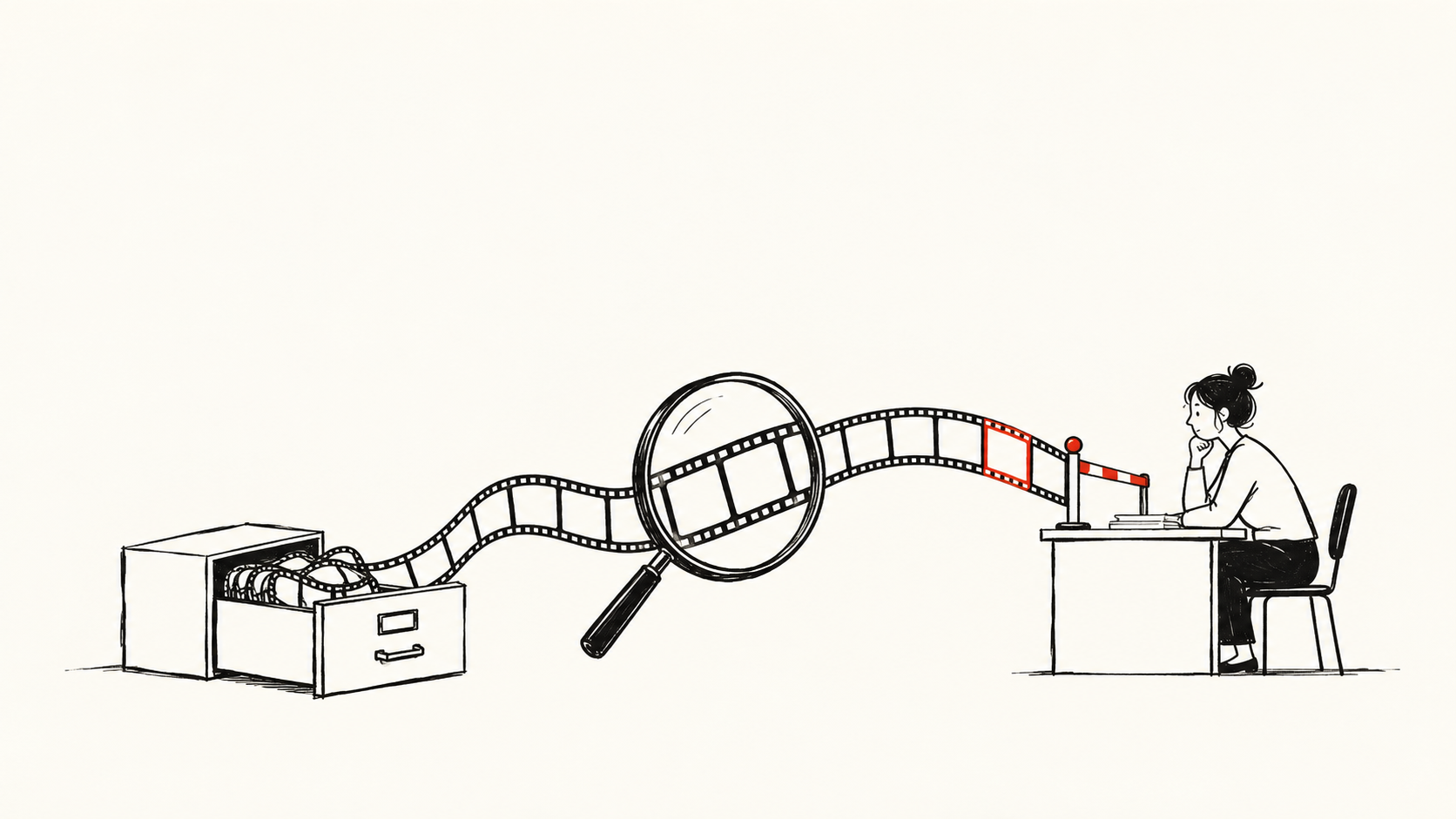
On October 19, 2026, NVIDIA announced expanded sovereign-AI cooperation with the European Broadcasting Union and developments in Adobe Frame.io video search. Company announcement
Better search is an attractive proposition for organizations with years of footage. Yet assessing its value requires a question that a smooth demonstration can obscure: after the system finds a shot, how much work remains before an editor can responsibly put it in front of an audience?
What follows is Open Market Notes editorial analysis. The workflow examples are hypothetical illustrations, not tests of these products or accounts of incidents at the organizations mentioned.
An archive contains conditions as well as files
Imagine an editor making a film about urban renewal who needs a view of the same street ten years earlier. A natural-language query could replace the need to remember a recording date or file number. Previously inaccessible material becomes a practical option. A small team might undertake a story it would otherwise abandon because finding the footage costs too much.
But a visual resemblance is only a starting point. The editor still needs the location, date and circumstances. A shot might depict an exercise, contain replacement audio or carry restrictions on territory and duration of use. Recognizing visual features cannot supply contracts or contextual information that never entered the archive system.
The difficulty is therefore not entirely model accuracy. Restrictions may live in emails, old project folders or a colleague's memory. Convenient search exposes those gaps. A budget for a new tool may also need to fund archive reconciliation. Otherwise, the organization exchanges an inability to find material for an inability to establish whether found material can be used.
Separate a candidate from permission to publish
A useful interface would treat search results as candidates rather than publication-ready assets. Each should lead back, where possible, to the original file, its surrounding sequence and known conditions of use. Missing information should remain conspicuous rather than disappear for the sake of a tidy screen.
This changes the objective of product evaluation. Measuring time to the first result rewards a fast, plausible answer. Measuring time to a usable shot includes checking context, rejecting mistakes and resolving permissions. The latter is closer to the editor's actual task.
A comparison could use a prepared set of ordinary footage alongside harder cases: the same location in different years, similar-looking people, missing labels and incomplete restrictions. Record omissions and misleading results as well as successful matches. A system offering ten candidates that take five minutes to review may outperform one offering three that take half an hour to verify. Speed needs to be assessed alongside the burden of verification.
This does not require every shot to undergo an equally elaborate approval process. Weather backgrounds, internal creative sketches and news footage involving identifiable people may warrant different release paths. The institution should deliberately make that distinction rather than allow search ranking to make it by accident.
Turn sovereignty into something that can be rehearsed
The EBU's July 2025 infrastructure position emphasized interoperability, resilience and control. EBU explanation
Building on those principles, OMN proposes testing concrete operational questions. If the model must be replaced, can existing labels and human corrections migrate? If connectivity fails, can staff still consult essential archives? When footage is withdrawn, do thumbnails, indexes and derivative versions enter a corresponding correction process?
These questions take more effort than asking where a server is located, but they come closer to operational independence. Both local installations and suitable cloud services require scrutiny of exit costs, permissions and maintenance responsibilities. Owning the machine does not restore missing archive context. Depending on a supplier need not remove every form of control. The relevant question is which controls are contractually specified and demonstrably usable.
For smaller producers, shared infrastructure and common interfaces may be more realistic than building independently. Sharing technology should not force identical editorial judgments. Historical footage serves different purposes in a documentary, an advertisement and daily news. Institutions need room to adapt the rules.
Avoid turning human review into a ritual
There is a serious competing view. In a speech published in March 2026, EBU news director Liz Corbin argued for reconsidering some traditional review practices for personalized news. Original speech
Adding another human click to every use can defeat the purpose of the tool. If people merely confirm machine conclusions without time to examine the underlying material, the approval log grows without necessarily improving judgment.
A more useful design directs attention toward uncertainty. Low-risk steps supported by sufficient traceable information can involve less repetitive work, while missing context, unclear permissions and sensitive candidates are escalated. Such arrangements still need sampling and revision. Passing a test once does not establish performance on new material, languages or situations.
For a purchaser, the announcement establishes a collaboration and product direction, not the return its own archive will produce. A bounded trial with explicit exit conditions is a better next investment: use real tasks, record total handling time, unexplained errors and rework, then decide whether to expand. The value of AI search depends on how a retrieved image becomes a defensible editorial decision.
Information only. No investment, legal, tax, or financial advice.