When AI shops for us, who decides which market we see?
Shopping agents reshape the choices we see, making coverage, commercial incentives and accountability central to their value.
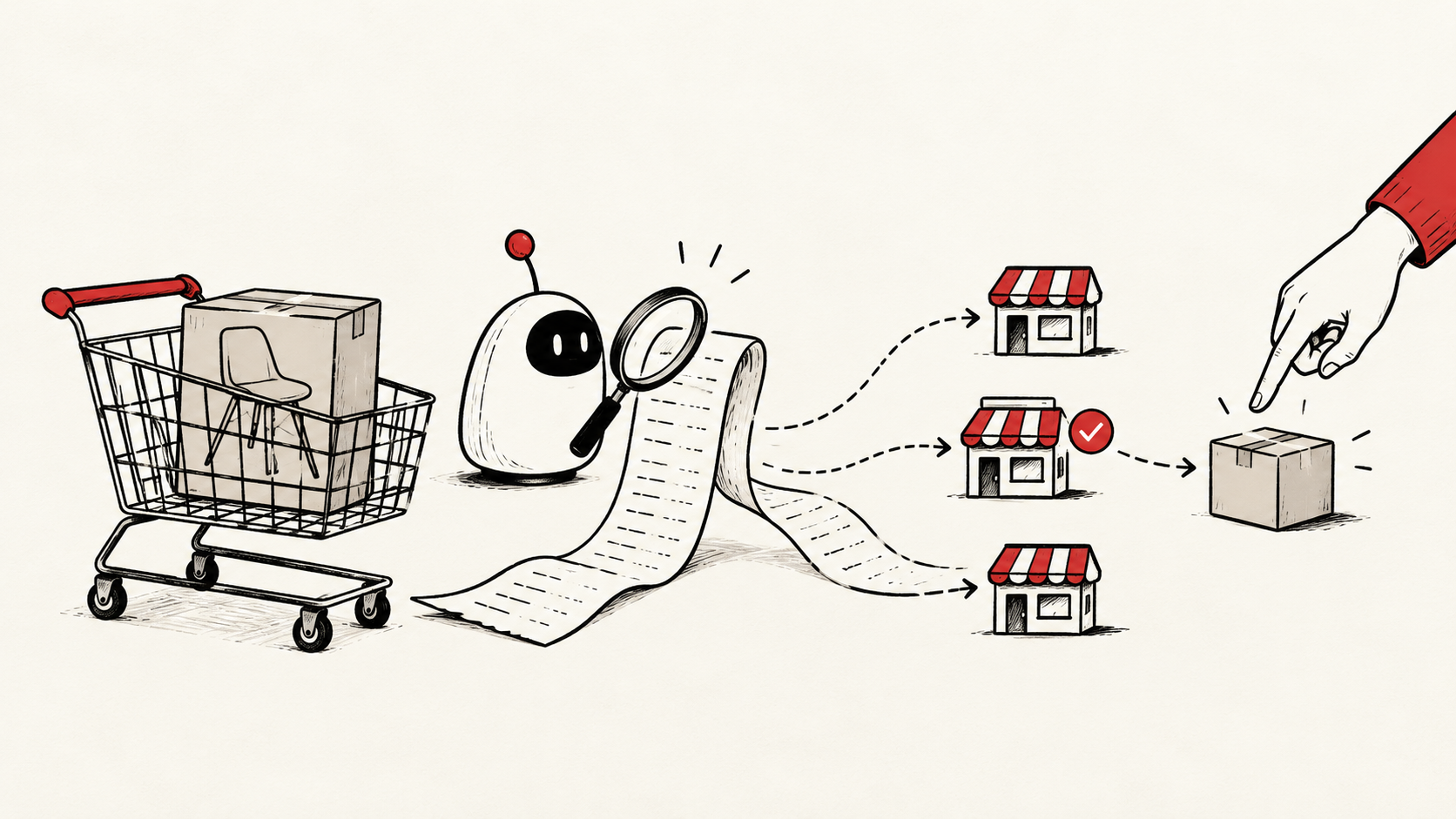
Someone asking AI to buy an office chair will rarely think of it as surrendering an important power. They state a budget, explain that the room is small and ask for something comfortable. Then they wait for a recommendation. If a few questions replace a dozen browser tabs, the attraction is easy to understand.
What is harder to see is how many choices have already disappeared before those answers arrive. Which shops the system can read, which prices it can confirm and which conditions it considers important all shape the recommendation. The consumer can still decide whether to buy. But the picture of the market on which that decision rests has already been arranged by another system.
This does not mean shopping agents must disadvantage consumers. Every comparison requires selection; nobody has time to examine an entire market. The question is what grounds consumers have for believing that an answer serves their interests when more of the selection is delegated to AI.
As of October 19, 2026, the public sources cited here do not establish that AI shopping is generally cheaper. They provide a starting point for examining the change. The shopping situations and institutional arrangements discussed below are Open Market Notes analysis, not tests of a particular service.
The market is arranged before the recommendation arrives
On January 11, 2026, Shopify announced Universal Commerce Protocol, co-developed with Google to standardize agent–merchant transactions. A technical connection makes some transactions possible. What should be recommended once that connection exists remains a separate question.
Suppose an agent can search shops A and B but cannot confirm shop C’s inventory. Its comparison between the first two may be accurate and conscientious. Yet if the consumer understands the result as the best choice in the market, they have accepted a judgment extending beyond its evidence.
No bad faith is necessary. Missing information, integration costs and whether a machine can interpret product details may admit one shop to the shortlist while leaving another out of view. The concern is that an answer valid within a limited field can be expressed with an authority that acknowledges no boundary.
Knowing which channels an agent checked, and why it could not compare others, is more useful than being told that it has found the optimal solution. Disclosing coverage cannot guarantee a correct recommendation. It can make clear what kind of judgment the buyer is accepting.
Product information presents the same difficulty. Two chairs may have the same model number, but one retailer includes delivery upstairs while another requires the buyer to carry the item. If only price survives the comparison, the machine treats two different transactions as the same product. The resulting ranking can be calculated correctly and still be unsuitable for someone without a car who cannot move furniture.
The more neatly a market is presented, the more important it becomes to explain consequential omissions. Consumers do not need every technical detail. They need the conditions that, if different, would lead them to choose something else.
A completed sale does not explain the boundaries of delegation
An agent’s ability to follow instructions does not mean it understands which costs the buyer is willing to bear. The cheapest chair within budget may not fit the room. An alternative available today may not justify abandoning the original choice. A request to “buy something suitable for me” often leaves these trade-offs unstated.
Anthropic’s September 24, 2026 Project Swap tested agents exchanging employees’ books. That controlled experiment cannot establish general retail competence. The practical question it prompts is what evidence should justify entrusting a particular choice to an agent.
For repeated purchases with precise specifications, the terms of delegation may be easy to define. Where comfort, taste and personal habits matter, buyers may discover their own preferences only through comparison. A question at that point is not necessarily a failure of the process. It acknowledges that part of the decision has not yet been authorized.
Google introduced AP2 on September 16, 2025, using signed mandates to link instructions with transactions, and announced its donation to the FIDO Alliance on April 28, 2026. Such arrangements help check permission; an authorization record alone cannot establish that a purchase was worth making.
An order may respect the spending limit and product category while overlooking the same item with better delivery terms. Permission to pay and sufficient grounds for choosing need their own evidence. Confusing them risks mistaking reliable execution for reliable judgment.
Why a service might prefer one answer
To understand how an agent chooses, examining the way it phrases an answer is not enough. We also need to know how the organization providing it measures success.
Imagine a team judged mainly on checkout completion. When the original item is unavailable, recommending an alternative that can be bought immediately may improve that measure. If evaluation also includes satisfaction after delivery, waiting for the original has a stronger claim to become a proper option. This is an analysis of incentives, not an allegation about an existing platform.
Nor must a commercial service have no interests of its own. Subscriptions, transaction fees and merchant funding are possible ways to operate. What needs explanation is the relationship between that revenue and the recommendation. A subscription does not by itself prove that comparison was thorough. Merchant payment alone does not establish that a recommendation is untrustworthy. Judgment should concern arrangements that can be examined, rather than praise or suspicion of motives.
Which merchants can enter a comparison? Does payment affect ranking? Can a user ask to see excluded candidates? These questions can receive concrete answers. Compared with a promise to put users first, they are easier to verify and more useful for assigning responsibility when a dispute arises.
The more an agent resembles a personal assistant, the more readily its advice may be understood as a judgment made specifically for the individual. That is a reason to explain its commercial relationships where that trust forms, rather than leaving users to discover them after something goes wrong.
Savings should be counted after delivery
Discussion of AI shopping’s advantages must eventually return to an intelligible account.
Suppose a buyer could otherwise obtain an item for 500 yuan. The agent finds the same item for 450 yuan and charges a 20-yuan fee. With other conditions equal, the buyer saves 30 yuan. This is only an illustration. Using a crossed-out list price of 800 yuan would substantially enlarge the advertised saving without giving the consumer anything extra. Their otherwise available choice is the reasonable starting point.
The accounting cannot stop at payment. If the item is unsuitable, returns, another search and correspondence with the retailer may consume the time previously saved. Reporting discounts only on successful orders removes the cost of failure from the account, just as comparing only connected merchants removes the unread part of the market from a recommendation.
Both cases present the same difficulty: what an evaluator sees depends on what enters the calculation. Without a stated scope, an attractive number may simply be an incomplete one.
Time has value, but saving half an hour on comparison does not increase wages by half an hour. Money and time can be recorded separately, allowing the user to judge the trade-off. There is no need to turn every convenience into income in pursuit of a larger benefit total.
A team preparing such a service could begin a credible test with a limited category. Give manual and agent comparisons similar budgets, delivery areas and substitution conditions, and continue the record until goods arrive and users can judge suitability. Failed orders should remain in that record. The result may be less striking than total transaction value, but it will be closer to the service consumers actually receive.
Convenience needs arrangements that can be questioned
Ordinary consumers cannot recheck every comparison an agent makes. If using a service requires repeating all of its work, much of the point of delegation disappears.
But avoiding that repetition need not mean accepting an answer without recourse. A service can retain verifiable comparison records, explain coverage and charges where they matter, and identify who will deal with mistakes. What needs explaining is observable evidence, not the model’s internal reasoning. What needs preserving is the opportunity to correct a decision, without making every purchase a technical inquiry.
Shopping agents deserve attention because they may reduce the effort required for tedious tasks. How much of that convenience stays with consumers cannot be inferred from checkout speed or a successful demonstration. It depends on adequate comparison, understandable charges and whether subsequent trouble actually diminishes.
Return to the office chair. The buyer may happily accept the recommendation without understanding every technical step. But when they ask why another shop was not chosen, a service worth relying on should be able to give an answer that can be checked. Delegation then has a chance to save effort while preserving the buyer’s practical control over the decision.
Information only. No investment, legal, tax, or financial advice.