AI servers need more capacitance, not a simple component-count forecast
AI-server component demand matters only after design requirements become qualified supply and deliverable orders.
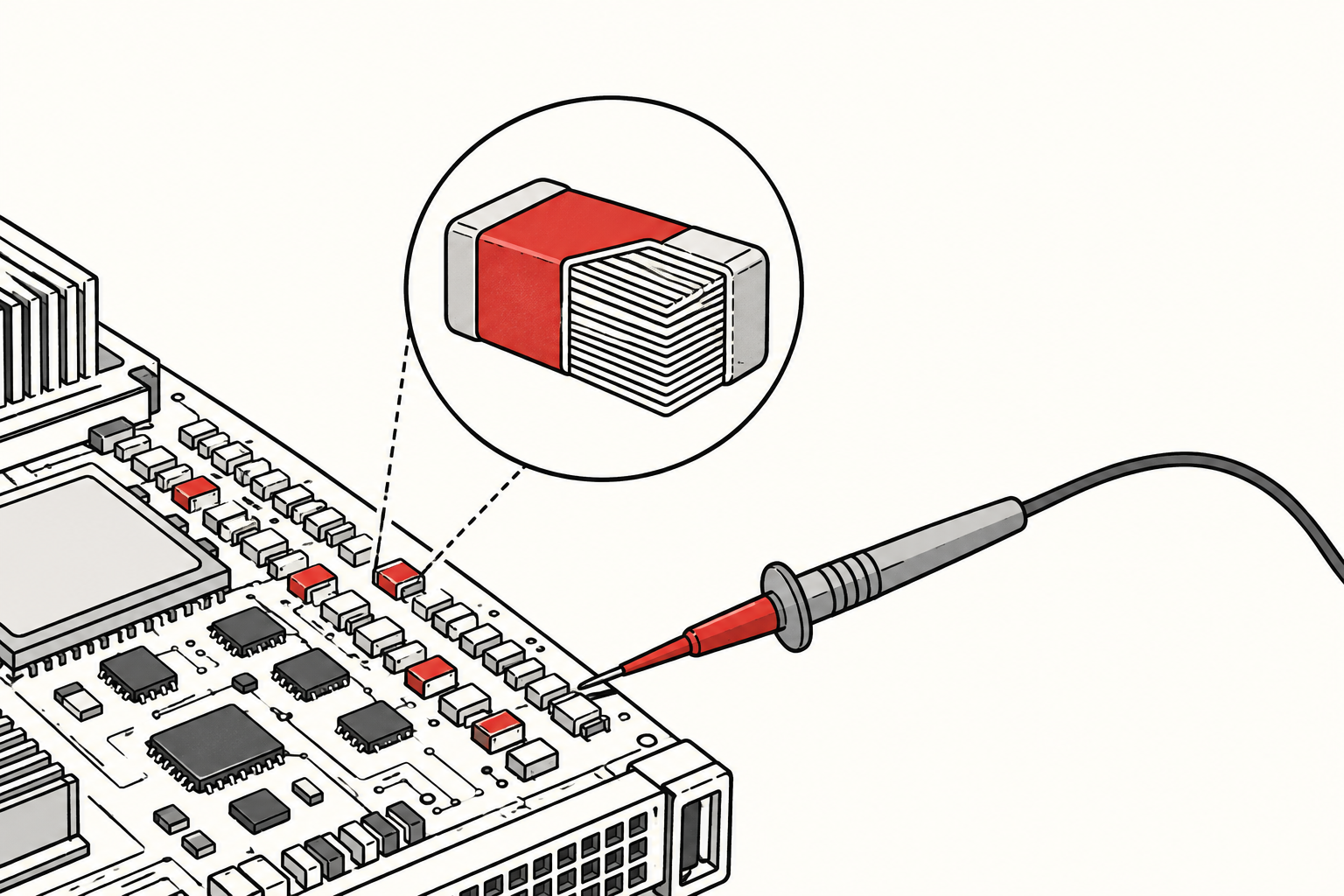
On October 28, 2026, Samsung Electro-Mechanics said in its third-quarter announcement that required MLCC capacitance per AI-server GPU doubles annually. This is the company's demand assessment, not a measurement of every server design.
The important question is not how to insert that multiple into an industry growth model. Capacitance, purchased component units and supplier revenue measure different things. Our argument is that understanding AI hardware expansion requires shifting attention from how many small parts are bought to how much supply meeting an actual design's requirements can arrive on time. This is engineering and procurement analysis based on public materials, not reporting from the company's customer projects.
Capacitance is not a component count
Imagine a future server board requiring greater total capacitance. A designer could increase the number of components, obtain more capacitance from each component, or combine those approaches. This hypothetical illustrates a measurement relationship; it does not describe a released GPU. A demand multiple cannot determine the chosen design, much less its selling price or margin.
Even if unit purchases rise, revenue depends on prices across specifications. Even with unchanged unit counts, a more demanding specification could change the product mix. Conversely, higher specifications do not guarantee higher profit: production costs, deliverable quantities and commercial terms still matter. Equating growth in AI computation, component units and revenue skips the links most in need of evidence.
The denominator also matters. Per GPU and per server are different boundaries, and a server configuration is not inherently constant. If a comparison between generations simultaneously changes GPU count, board architecture and component specifications, the entire change in procurement spending cannot be attributed to rising usage of one part. A testable comparison first fixes its system boundary and then identifies what changed.
The relevant specification is the one in operation
Murata's technical guidance explains that DC bias can reduce the effective capacitance of high-dielectric-constant ceramic capacitors; actual operating conditions, not nominal values alone, require validation.
That gives supply analysis a concrete constraint. Consider two quotations listing the same nominal capacitance. The buyer actually needs components satisfying a particular board's requirements. Declaring them interchangeable because the printed number matches would leave the evaluation unfinished. Meeting the required performance is not the same question as whether visually similar parts exist in a warehouse.
It follows that any shortage claim should identify what is scarce: a part number, a package category, a substitute approved for a project, or capacity in general. The first could be tight without the last being universally inadequate. Turning a local specification constraint into a permanent industry-wide deficit would convert an engineering problem into an unconditional commercial claim.
Samsung Electro-Mechanics' AI-server application diagram lists MLCCs around CPUs/GPUs, voltage regulators, memory and network switches. It is an application illustration, not a customer's bill of materials.
GPU count is therefore only a starting point for estimating complete procurement needs. A more useful object of analysis is the system design: which section changes specification, which parts can remain, and which require renewed evaluation. This does not assert that every design lengthens qualification. It cautions against pretending a system-level estimate is complete without its actual component requirements.
A long-term contract buys predictability, not realized profit
An independent piece of evidence is the September 1, 2026 contract announcement: Samsung Electro-Mechanics reported an AI-server MLCC supply agreement with an unnamed customer, covering deliveries in 2027.
That agreement belongs on the correct timeline. Future deliveries differ from revenue already earned in the current quarter. Announcing a supply relationship does not reveal every pricing, acceptance or adjustment provision. It is evidence of advance supply-and-demand planning, not a disclosure of eventual profit per component or the customer's identity.
In incentive terms, a buyer wants to reduce the risk that a crucial input disrupts a system plan; a seller wants to reduce the risk that investment and orders become misaligned. This describes the economics of contracting, not undisclosed terms of this agreement. Their shared interest in predictability can explain the value of a longer arrangement without proving that risk has disappeared.
Likewise, greater confidence in future demand does not give every capacity addition equal commercial value. If new supply does not match ordered specifications, a broad expansion figure is not equivalent to deliverable product. Conversely, alternative designs could enlarge qualified supply and ease a previously tight specification. Constraints must be monitored rather than permanently diagnosed from one announcement.
What would change the interpretation?
The next useful evidence is not simply a larger demand multiple. It would connect three relationships: how system requirements become specific components, how those specifications become qualified deliveries, and how deliveries become commercial results. This does not demand customer secrets. It asks analysts to acknowledge which part of the chain is currently visible.
A stronger interpretation would gain support if demand across projects consistently became deliverable orders while the benefits of specification upgrades were not offset by costs. A more cautious interpretation could be supported if substitution, order adjustments or additional supply changed the original scarcity. These are possibilities to test, not developments this article claims to have observed.
The latest company statement brings the small parts surrounding chips into the AI-infrastructure discussion. The available evidence does not establish a universal cost per GPU, an industry-wide unit growth rate or a profit trajectory. The defensible conclusion is that demand intensity passes through a series of conversions before becoming usable supply and financial results. Examining those conversions is more informative than treating capacitance growth as revenue growth.
Information only. No investment, legal, tax, or financial advice.