Where an AI idea becomes a factual claim
Useful AI exploration needs room for unusual proposals and a clear boundary before those proposals become public claims.
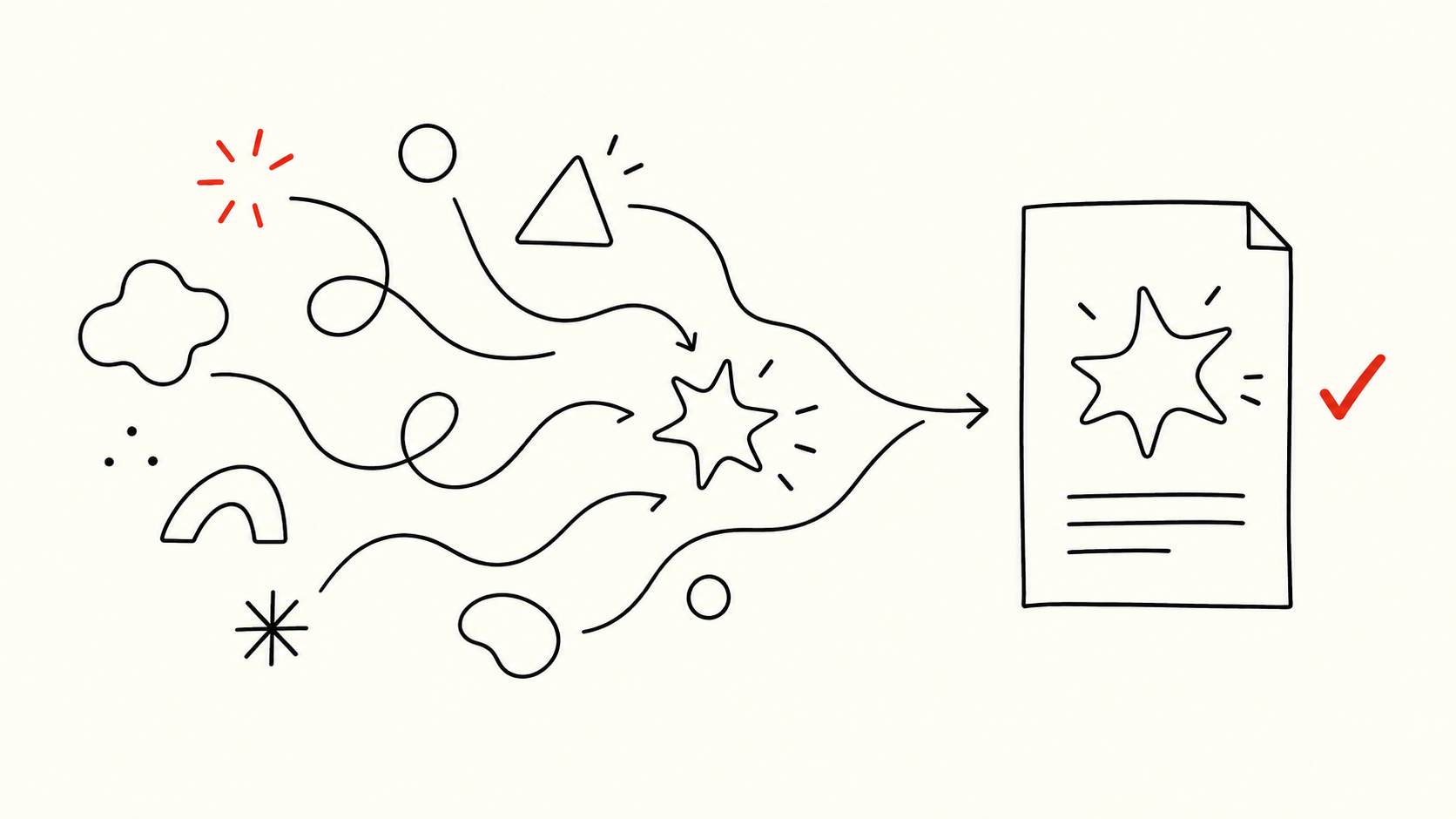
An AI assistant helping a public library imagine new services can legitimately suggest something nobody has tried. The same assistant preparing a funding application cannot legitimately invent evidence that residents already want it. Both jobs may happen in one conversation, with the second document assembled from the first. The consequential change is easy to miss: a possibility has acquired the authority of a statement about the world.
An MIT interview published October 23, 2026 describes historian Benjamin Lindquist’s account of early AI researchers’ interest in surprising outputs. His historical paper appeared October 19. That history offers a reason to reconsider what we ask of a system. It does not establish that today’s language models must fabricate facts to be creative. A history of researchers’ ambitions cannot by itself settle that technical causal question.
This article’s argument concerns the work around a model: how to preserve the usefulness of invention while controlling the point at which a generated sentence becomes an accountable claim. Treating every unusual answer as a defect would narrow exploration. Treating an attractive proposal as evidence would undermine the decision that follows.
A proposal changes status as it travels
Consider a hypothetical library planning workshop. An assistant proposes a late-evening mobile reading room near a transit stop. This is an invented service concept, not a report of an existing project. The team can ask whether it would reach people excluded by ordinary opening hours, how its location would affect access, and what a small trial might teach.
Now suppose a later draft says that local shift workers have requested this service. Unless a real consultation supports that sentence, the draft has crossed a factual boundary. The original idea may still be worth exploring. Removing the unsupported claim does not require abandoning it; it requires describing the demand as something to investigate.
The distinction applies within a single paragraph. A proposal can contain factual premises about closing times, a hypothesis about unmet need and an imaginative response to that hypothesis. These components need different treatment. Existing opening hours can be checked against a current notice. Unmet need calls for observation or consultation. The proposed service needs comparison with alternatives. A general instruction to “be creative but accurate” leaves those different obligations unresolved.
The danger also arises during editing. A qualified sentence becomes a shorter executive summary; the summary supplies a slide; someone else copies the slide into an application. A provisional assumption can lose its label without any new evidence being added. Fluency and repetition then make it feel established. A sensible review should therefore examine changes in evidentiary status, not merely spelling, style or whether the final answer resembles the earlier draft.
More suggestions do not necessarily widen the choice
A Doshi–Hauser short-story experiment, published in 2024, found higher individual creativity ratings with AI ideas, alongside greater similarity among the resulting stories. The setting matters: this is evidence about a writing experiment, not a prediction for every policy workshop.
For our hypothetical library, the useful implication is a question to investigate. Are the alternatives genuinely different, or are they polished variations on the same assumption? Ten proposals that all presume unmet evening demand offer less practical choice than a smaller set that examines different causes of low participation. Transport, language, awareness and service relevance would imply different interventions. These are possible explanations in the example, not findings about any actual community.
A team can retain its own initial observations before requesting suggestions, then compare the generated options against them. It can also ask what evidence would make it reject each proposal. That creates a way to discriminate between ideas without demanding that every early suggestion arrive fully proven. Novelty becomes a starting point for inquiry rather than a substitute for it.
Confidence needs a route back to evidence
There are technical tools for inspecting generated claims. SelfCheckGPT, first submitted March 15, 2023, investigated detecting unsupported generated biographical statements through inconsistencies across sampled responses. Such work motivates scrutiny, not automatic acceptance of whatever survives a check.
For a publication decision, repeated agreement from a model should still be treated as repeated output rather than as independent documentation. The relevant question remains whether an accessible source supports the particular claim, in the relevant place and period. A source about another city’s trial might suggest a method. It would not establish demand in this library’s neighbourhood.
This distinction also makes uncertainty more useful. “We do not yet know” need not end the planning process. It can identify the next action: observe the location, consult potential users or run a limited trial. Conversely, attaching a vague disclaimer to an otherwise confident funding application does little to show which premises remain untested. Uncertainty should stay with the specific assertion it qualifies.
An editorial boundary worth maintaining
A practical workflow could keep exploratory material separate from text intended for external use, while allowing ideas to move between them. When an idea enters a decision document, its factual premises would need explicit support, its assumptions would remain visible, and its proposed effects would remain prospective until observed. This is an editorial design proposal, not a tested guarantee of reliability.
The boundary has costs. Checking every passing idea would slow discussion and discourage useful departures. Checking only the finished document risks discovering too late that several pages depend on an invented premise. The more workable point is when a premise begins to justify a choice, a budget or a public assurance. That is where its status matters to someone other than the person brainstorming.
No such process resolves what creativity ultimately means, or ensures that an experiment will succeed. It does provide a more precise responsibility than demanding a single balance between imagination and accuracy from every model response. In the library example, the next defensible output would be a proposal with an honest account of what remains unknown and a feasible way to learn it. The unusual idea can remain. The evidence still has to be obtained.
Information only. No investment, legal, tax, or financial advice.