Why a drawable part may still need redesign
AI-assisted design must account for tolerances, assembly sequence and the cost of changes made late.
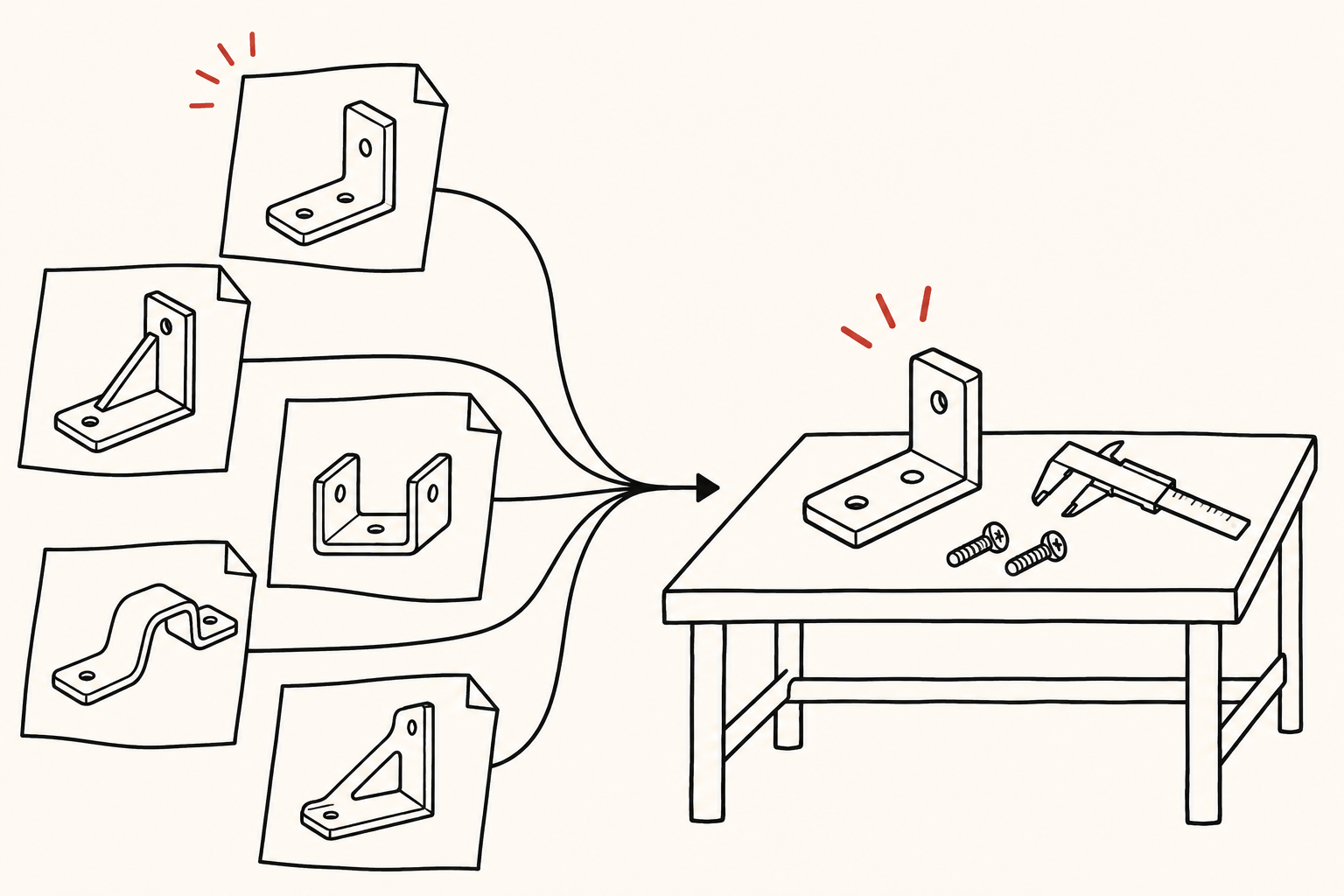
On November 3, 2026, OpenAI reported AI-assisted physical design, while acknowledging that manufacturing still required reviews and iteration around tolerances and assembly. Source: OpenAI
The development is worth examining through when manufacturing constraints enter a design. As drawings become easier to generate, can machining and assembly conditions influence a proposal before its structure is settled? What follows is Open Market Notes analysis. We do not treat a vendor demonstration as independent proof of production efficiency or estimate undisclosed savings.
Where a change happens determines what it affects
Imagine a desktop-device project that needs to fit a circuit board into an enclosure. Moving a mounting post early on may appear to change only one position in a model. If the board layout, connector openings and fastener choices have already been settled around the old location, the same move may require several parts to change together. Its economic cost comes from the dependencies affected, not simply the minutes spent editing geometry. This is a hypothetical explanation of a mechanism, not project data disclosed in the demonstration.
Lower modeling effort may make trying new structures easier without reducing the cost of associated downstream work. If a new design retains process assumptions from an earlier version, fast editing may even obscure the coordination that is now necessary. A more useful assistant would explain which mating surfaces, tool-access paths and assembly steps a proposed change affects, allowing engineers to compare whole arrangements rather than attractive shapes alone.
Assembly sequence is especially easy for static images to conceal. Two parts may not interfere in their final positions, yet a worker may be unable to insert them along the intended path. Space for a screw does not necessarily leave access for a tool after other components are fitted. Moving a support to shrink an enclosure may complicate a previously simple step. A design therefore needs to describe intermediate states, not only its finished appearance.
That matters for product economics. A lighter or less material-intensive part may require extra assembly handling that offsets its local saving. Conversely, a roomier structure may make an operation more consistent. Neither is a universal judgment; the actual process must be compared. If AI helps surface these conditions earlier, it could reduce rework caused by late discoveries. Public evidence does not yet quantify that effect.
Tolerances connect geometry to production
In the hypothetical device, enclosure posts and circuit-board holes align perfectly at nominal dimensions. Actual parts vary. A tight fit may require additional assembly work; indiscriminately increasing clearance to simplify assembly may weaken retention. This is not a safety assessment of a particular product. It illustrates why a design must explain fitting together, staying together and being manufactured consistently.
Tolerances consequently have an economic role. Tighter requirements may imply different processes, additional inspection or greater scrap risk; looser requirements may call for structural changes. They should not be treated merely as numbers added after a drawing is finished. In choosing a shape, the team is also choosing what a supplier must achieve, which deviations are acceptable and who deals with them.
AI might help compare these relationships rather than simply recommend more elaborate geometry. Engineers could ask candidate designs to distinguish dimensions governing fit from aesthetic preferences, then examine which requirements survive a change in manufacturing method or assembly sequence. Whether this saves money depends on having real production constraints as inputs. Without supplier-capability information, an elegant comparison may merely organize untested assumptions.
What question should a physical test answer?
NASA's product-verification guidance distinguishes compliance with specified requirements from suitability for intended use. This is engineering context, not a claim that consumer products must adopt the complete aerospace process.
For the enclosure, a team can ask separately whether hole locations meet the drawing and whether operators can assemble it consistently in the intended process. Success on the first question does not settle the second. Conversely, one successful manual assembly does not establish that the drawing supports continuing production. Separating the questions clarifies whether the next evidence should come from dimensional measurement, assembly observation or a structural change.
The distinction also affects experimental value. If two alternatives appear similar in simulation, instead of building one attractive sample of each, the team could first identify conditions under which their behavior might differ. Testing then helps choose between designs rather than simply produce demonstration material for a favorite. This is a resource-allocation proposal; the appropriate testing intensity still depends on use, failure consequences and applicable requirements.
NASA's modeling and simulation standard requires projects to define acceptance criteria. Its terminology also treats model validity in relation to intended use. These references supply a useful reminder: a model suitable for screening shapes may not answer a question about another process or environment. However orderly its results, readers need to understand the scope it is meant to explain.
Returning manufacturing feedback to the start of design
When a supplier identifies a difficult-to-make feature, the useful record is not simply that the proposal was rejected. It also includes the equipment, material and assembly sequence under which the problem arose. Keeping only the final drawing may allow the next generation of proposals to rediscover the same difficulty. Manufacturing experience becomes useful input when its applicable conditions accompany it.
Nor should that input become an immutable rule. Supplier capabilities change, and another process may remove an earlier limitation. Retaining the source, confirmation date and scope lets another engineer see both accumulated experience and room for reassessment. The organizational asset is then more than a collection of drawings: it includes reasons for structural choices.
Evaluation of AI-assisted engineering should also move beyond drawing speed. Useful observations would include whether fewer problems surface only after machining or assembly begins, whether a structural edit alerts affected teams earlier, and whether reduced part costs coincide with higher costs elsewhere in the process. These are proposed evaluation directions, not established improvements in metrics.
The optimistic interpretation is that AI helps designers compare complicated interactions earlier. The cautious interpretation is that faster generation merely sends designs lacking manufacturing scrutiny downstream sooner. The difference is whether constraints genuinely change the design. For a physical product, drawing a part is a beginning. Incorporating the production process into the design rationale may make the next modification disturb less work that has already been settled.
Information only. No investment, legal, tax, or financial advice.