AI-written circuits still have to pass the engineering gates
AMD’s reported GPU-IP PPA gains are not whole-GPU speedups. The key is how candidate circuits survive verification and implementation.
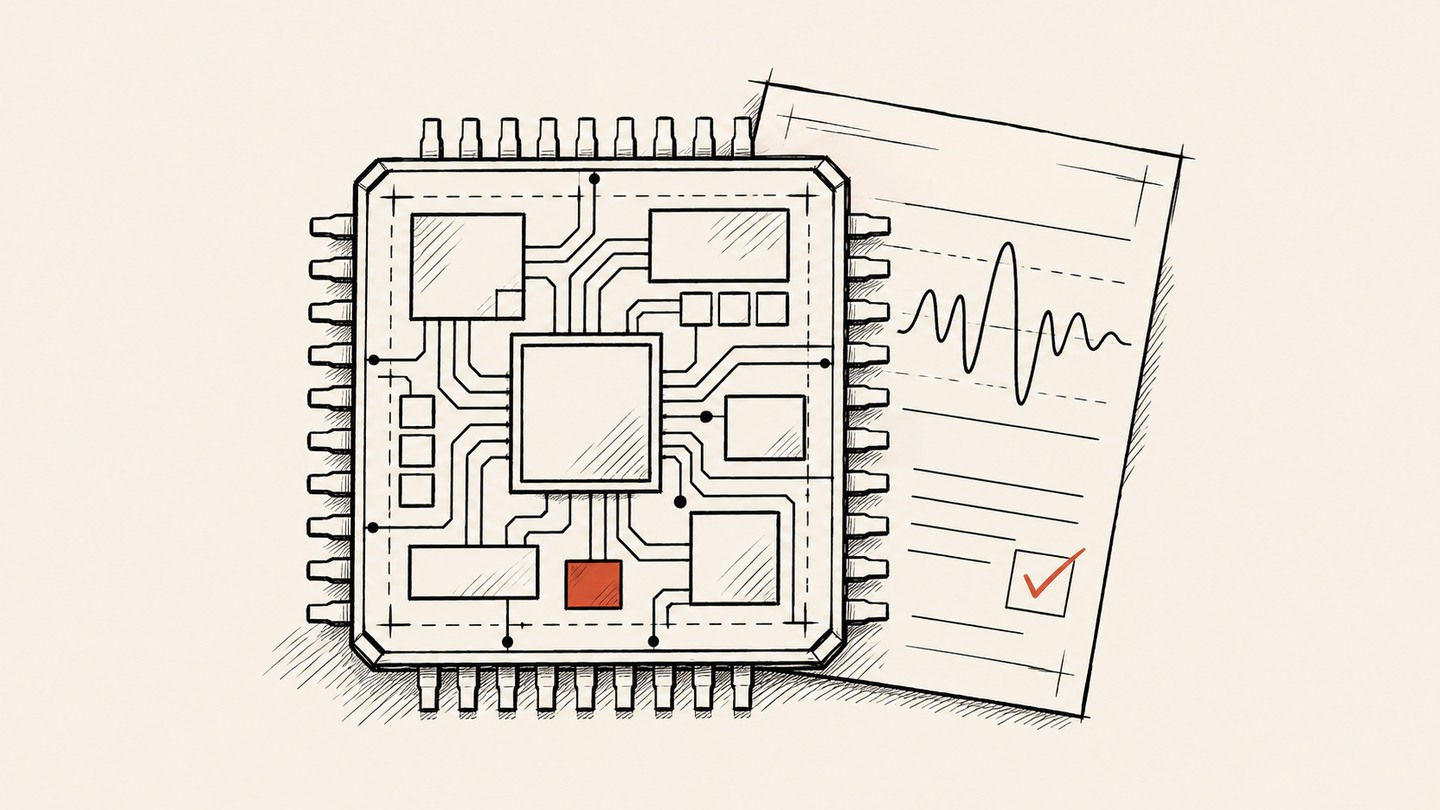
OpenAI’s November 18 disclosure reports up to 14% PPA improvement on AMD flagship GPU IP, with some changes included in a design sent for manufacturing. That is an engineering milestone, not a measured whole-GPU speedup or evidence that corresponding commercial products have shipped. Original disclosure
PPA means power, performance and area. Assessing AI-assisted chip design requires preserving those dimensions and the stage of evidence. Candidate code, a checked module, a physically implemented design and working silicon answer different questions.
Establish what must stay unchanged
RTL describes circuit behavior and data movement. A rewrite can change the implementation, but interfaces, numerical semantics, reset behavior and permitted latency must respect the requirements. A shorter expression need not produce a smaller circuit, and removing an operation can alter an edge case.
Imagine a floating-point block that produces correct everyday answers but loses a bit under a particular rounding condition. Random tests might miss it while real software can still encounter it. This is an illustrative acceptance problem, not an allegation about AMD.
Simulation checks the scenarios exercised. Formal equivalence compares old and new behavior within the chosen model and conditions. Synopsys distinguishes the approaches and explains sequential equivalence for changes across clock cycles. Technical explanation Passing tests is valuable, but is not automatically proof of every permitted behavior.
Formal verification also has boundaries. The reference design, reset assumptions, uninitialized state and treatment of don’t-care values shape the claim being proved. EQY’s documentation explains how unknown values affect safe replacement. YosysHQ documentation A pass must travel with its configuration; it does not independently establish that the original specification was complete.
One PPA gain does not replace the objective set
Suppose a block occupies 10% of the relevant standard-cell area and shrinks 14%, with everything else unchanged. The corresponding total falls 1.4%. This is arithmetic, not AMD’s layout or an estimate of its GPU gain. Memories, interconnect and other logic cannot silently be treated as the same measurement scope.
Timing needs similar care. Fewer pipeline stages may reduce cycles per operation while lengthening the combinational path and lowering attainable frequency. Throughput, response latency and area must be traded against the workload objective. Power also requires activity and measurement conditions, not merely a count of circuit elements.
The best candidate is therefore conditional. A design suited to throughput per area may be unsuitable under a strict latency limit. If an evaluation accepts omitted functionality that the product still requires, its winning score cannot be transferred unchanged. Requirements should be fixed before candidates are compared.
Entering design files is not the final gate
A credible acceptance process reproduces the baseline, records modifications, checks behavior and compares implementations under consistent tools and constraints. This is an evaluation framework, not a reconstruction of undisclosed AMD procedures.
A successful module must also return to the larger design. Local logic savings can bring routing or interface costs. Block-level results do not identify the system bottleneck. Integration needs to establish that a saving has not merely moved work elsewhere or changed software-visible behavior.
Sending a design for manufacturing is an important milestone. Returned silicon still requires bring-up and functional and performance validation. OpenAI’s August Jalapeño disclosure discussed working silicon and system tests while still listing production qualification and deployment preparation. Earlier Jalapeño disclosure That is a useful stage comparison, not evidence of undisclosed silicon results for the AMD design.
Evidence worth following
The most useful next disclosures identify the block, metric, baseline and verification coverage. Physical-implementation results need timing and power conditions. System measurements need workloads and the surrounding configuration.
Productivity evaluation should also count rejected candidates and human review. Generating ten designs rapidly, with one passing, does not establish how much the full schedule shortened. Search, tool execution, debugging and integration all consume time; their accounting shows where savings actually occur.
The significance is that model-generated circuit changes are being adopted in real engineering workflows. Larger conclusions need evidence at each subsequent gate. Verification and implementation tools determine which proposals survive and precisely what they improve.
Information only. No investment, legal, tax, or financial advice.