When does an AI-assisted order become additional business?
A commerce assistant should be evaluated through incremental orders, service costs and outcomes that arrive after checkout.
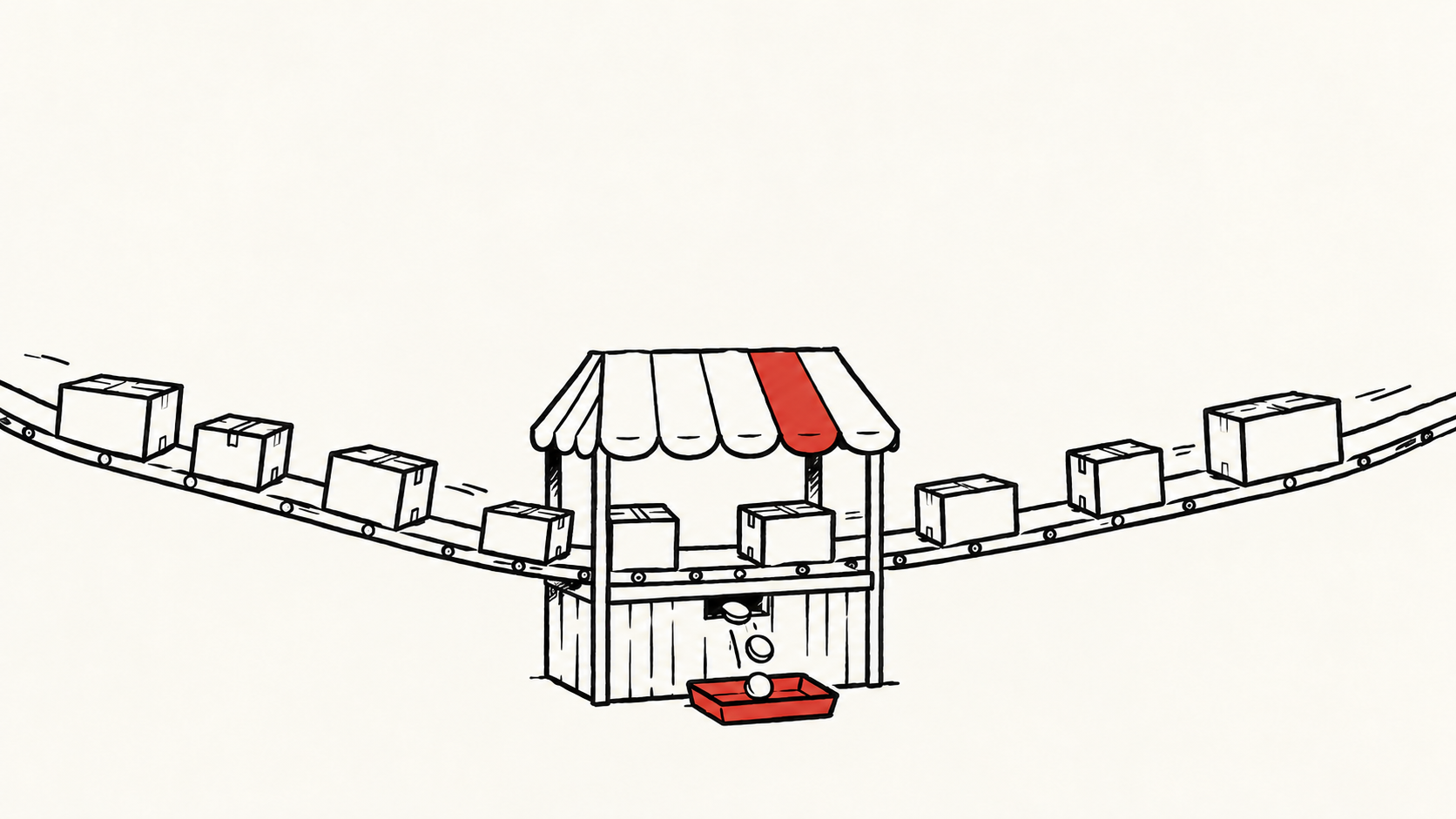
Google’s 21 October 2026 e-Conomy SEA update forecasts regional digital-economy GMV of US$368 billion for 2026. Temasek’s accompanying release identifies Google, Temasek and Bain & Company as the report’s publishers. That market outlook is a useful starting point for a commerce team. It does not tell the team whether its next AI feature will generate additional business worth the cost of serving it.
The distinction becomes practical when a shopping assistant moves from answering questions to helping finish an order. A dashboard can credit the assistant for a purchase without establishing that the purchase would otherwise have been lost. Even a genuinely additional order can leave little after discounts, delivery and subsequent service. The analysis below develops an editorial framework for evaluating this gap. Its business examples are hypothetical, not cases reported by the companies cited.
The decision changes the relevant denominator
A merchant choosing a product category, a marketplace setting commissions and a software supplier pricing an assistant are looking at different pools of money. A broad transaction measure can help locate demand. It cannot be transferred unchanged into each business plan. The merchant needs to sell and fulfill goods; the marketplace must provide a service somebody will pay for; the software supplier must identify which customer receives enough value to renew.
This is also why revenue comparisons need care. IFRS guidance on principal-versus-agent assessment centers on whether an entity controls the specified good or service before transfer. This is an accounting reference, not a classification of any company here. In our analysis, an interface that displays the entire basket has not thereby earned the basket’s entire value. The contract, service provided and costs assumed determine what the business can retain.
A team should therefore first state the decision it is trying to make. “Should we support this category?” calls for evidence about reachable customers and service capacity. “Should we make the assistant available to everyone?” requires evidence about incremental economics across the people who would receive it. A market-size forecast cannot substitute for either investigation.
Assisted orders and additional orders can diverge
Consider a hypothetical shopper who has already selected an appliance. She asks an assistant whether it fits a particular space, then pays. The assistant may have resolved a genuine obstacle. It may instead have answered a question she would have resolved from the specification sheet. Both paths can look identical in an assisted-order dashboard.
The reverse can occur too. An assistant may advise someone that a product is unsuitable. There is no immediate sale to credit, yet an avoidable return or disappointed repeat customer may have been prevented. Treating every abandoned basket as failure would encourage a feature to persuade rather than clarify. The desired behavior has to be specified before its commercial effect can be judged.
The useful comparison is between outcomes with the feature and outcomes under a credible alternative. Microsoft Research’s work on online experimentation explains how randomization and appropriate design support causal assessment. Applied to this hypothetical decision, assigning eligible shoppers before they choose whether to use the assistant is more informative than comparing enthusiastic users with everybody else. The latter groups can differ in purchase intent before the feature does anything.
An experiment still needs judgment. If shoppers return through several devices or share a household account, assignment may not map neatly to an independent customer. A small merchant might not have enough traffic for a reliable test. In that case, uncertainty should remain visible; a before-and-after improvement during a promotion is not a substitute for a defensible comparison.
The order must be followed beyond checkout
Suppose two hypothetical merchants record similar increases in completed orders. One mainly sells products with clear specifications and predictable delivery. The other sees more orders requiring substitutions, cross-border handling or post-purchase explanations. The same apparent lift can create different workloads and cash requirements.
For this decision, we would define a contribution measure that begins with the revenue the business actually retains, then deducts the costs that change because those orders exist. Depending on the business, these may include discounts it funds, payment processing, fulfillment, returns, model usage and human escalation. This is an analytical measure, not a claim about a company’s reported gross profit or a universal accounting formula. Its boundaries must be disclosed and kept consistent between the alternatives.
The measurement window matters as much as the formula. Counting purchases immediately while stopping observation before deliveries and returns finish favors a fast-selling treatment. Comparing mature orders in one group with recent orders in another can create an advantage that disappears with time. Where outcomes are still pending, showing separate order cohorts is more honest than presenting an apparently final margin.
Missing events are part of the result
An assistant can make the customer journey easier while making the measurement system harder to join up. A conversation, order, refund and support ticket may live in different systems. Research on telemetry loss warns that missing outcome measurements can bias experiment conclusions. A company should not silently treat missing records as successful transactions or as zero cost.
In the hypothetical appliance case, the minimum useful audit follows the assigned shopper group through the order and its later service events. It need not retain the whole conversation indefinitely. The objective is a sufficiently reliable link between the intervention and the business outcome, with appropriate limits on the information collected. If one group loses more records, the published result should describe that gap before making a profitability claim.
A positive case can survive a narrower claim
None of this means an AI commerce feature must produce a dramatic sales lift to be useful. It might reduce the time needed to handle routine questions, improve the quality of orders or help existing staff serve a wider catalog. Those benefits can justify a different business case, provided they are measured rather than relabeled as incremental sales.
There are competing explanations for a promising launch. Better assistance could improve decisions; a subsidy could temporarily increase purchasing; more prominent placement could capture customers who were already coming. These possibilities imply different decisions about pricing, staffing and expansion. A team that separates them can stop paying for the wrong mechanism without discarding a useful product.
The regional report provides context for where commerce businesses are looking. A deployment decision needs a more local account: which customers were eligible, what changed for them, what the business retained after service, and which outcomes are still unknown. That account is less impressive than a regional headline, but it is closer to the evidence needed to decide whether to expand the feature.
Information only. No investment, legal, tax, or financial advice.